


Gravel Race: Hamburg’s Backyard: Interview with Lisa Alice Paus: “Bloody hell, Lisa. The remaining kilometres aren’t right…”
Laurin Lehner
· 11.08.2026

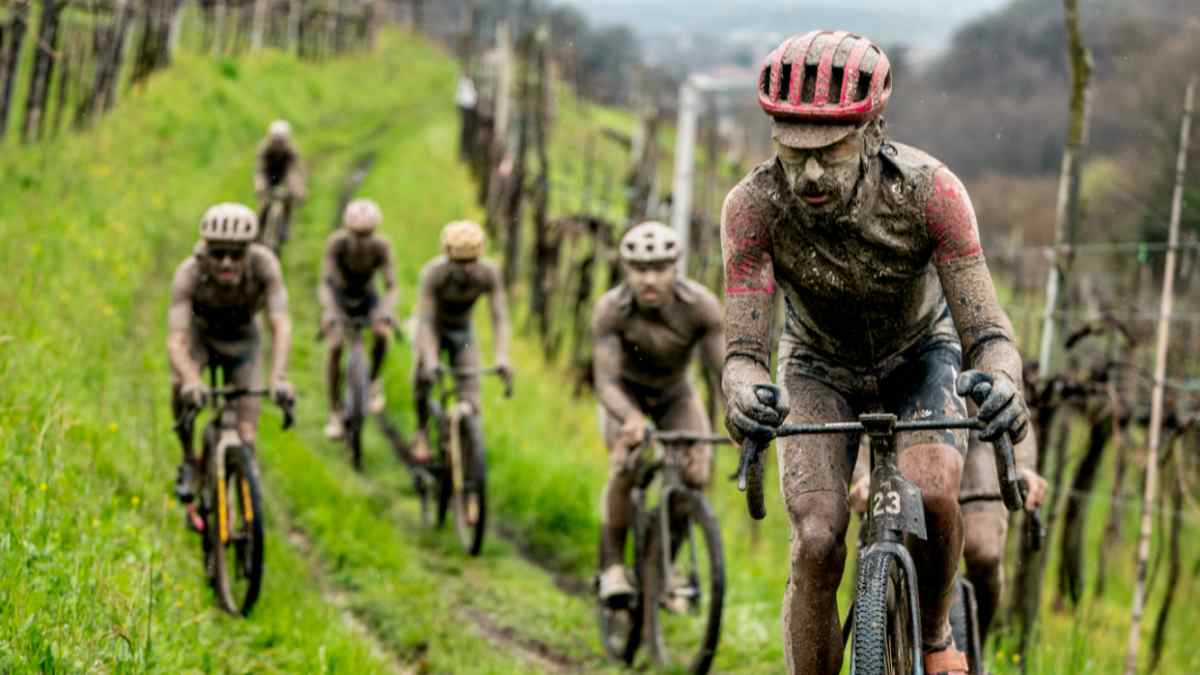
Anyone taking part in this race must not only be physically fit, but above all have a strong mind. The route takes you through varied terrain, over cobblestones and gravel sections, and through nights when your mind starts to play tricks on you.
You can ride solo or as part of a team – anyone who wants to share the ordeal can enter the pairs category. For beginners, there’s the Nightshift, a 250-kilometre route, so you can at least get a taste of what it’s like to power through the night.
We spoke on the phone to Lisa Alice Paus, one of the participants, who took part in the race alongside her husband.
Interview with Lisa Paus: “Two nights without sleep were completely new territory for me until then.”

Lisa, you took part in the pairs category at Hamburg’s Backyard with your husband. 700 kilometres – without any support, all in one go.
The Hamburg’s Backyard was our first long-distance, unsupported gravel race together. My husband has a wealth of ultra-distance experience from his road cycling days – among other things, he’s already completed the Race Across America. Although we’d previously ridden brevet series together covering up to 1,200 kilometres, I was still a long way from matching his experience. And an unsupported race on a gravel bike with very little sleep was simply something else entirely. That made it all the more wonderful to have him by my side on this adventure.

So, how did it go?
All in all, it went really well – well, if we hadn’t got completely lost that night. We drove straight through the first night, and before we were due to head back towards Hamburg, there was another loop of about 80 kilometres that we had to do. We simply missed it. At three in the morning, my husband looked at the speedometer and just said: “Bloody hell, Lisa. The remaining kilometres don’t add up at all… we’ve missed something.”
And then what?
At first, we were completely flabbergasted. My husband’d had enough by then and said, “Lisa, I’m out. There’s no way I’m cycling those 40 kilometres back over cobblestones and gravel sections.” We’d lost ages, after all. But under no circumstances did I want to give up or be disqualified. After a heated discussion, we did what we always do at home when we can’t agree: rock, paper, scissors. Fair’s fair – and luckily, I won!
Wow, and did your husband go along with it in the end?
Well, not exactly by choice! But a race is a race – whoever wins gets to decide. I insisted on it quite firmly, too. I quickly rang the race director to check whether we could at least cycle back along the road to the loop we’d missed. Fortunately, that was fine. After that, though, there was two hours of complete radio silence between us on the bike… Until we arrived at the checkpoint and realised we were still doing really well in the race. That’s when our motivation returned, the atmosphere was back, and we just saw it through together.

How did you get into cycling?
Looking back now – I think it’s been seven or eight years since I first started cycling. Before that, I used to ride horses professionally. When I stopped, I initially took up running to make up for it somehow. And I actually only got into cycling by chance – because of a running injury that just wouldn’t clear up. I then bought my first bike so I could carry on training in some way. And then… I got hooked, I have to say. Cycling just never let me go.
And then, at some point, you bought yourself a gravel bike?
Yes, exactly. I did start out on a road bike, though. After about a year, I met my now husband at a bike fitting. He and lots of people in our circle of friends were already doing loads of gravel riding back then. He was just really keen for me to join him on his rides – and ended up giving me a gravel bike as a present.
When was your first gravel race, and what was it?
My first official race was actually Fudenas – strictly speaking an MTB race, but we simply turned up at the start on our gravel bikes. After that, I did ride in a few other events, but those were more traditional, shorter-distance races. Apart from the racing scene, we’ve always really enjoyed going on longer gravel rides anyway.
One absolute highlight was our honeymoon: together with some of our wedding party, we cycled the Badlands route over four days. The scenery was simply stunning. Taking part in Hamburg’s Backyard, however, was actually my very first long-distance, unsupported race on a gravel bike – and that was a whole different ball game.
There’s the bikepacking crowd – taking it nice and easy whilst enjoying the scenery. And then there’s this night-time rush, chugging energy gels, sleep deprivation. What fascinates you about it?
Yes, that’s exactly what you keep asking yourself during the race. Really. You cycle past the most beautiful places – in the dark. You don’t enjoy your food; you’re just trying to get calories down as quickly as possible. We hadn’t slept for two nights, and at some point along the route you just find yourself thinking: Why? Why on earth are we putting ourselves through this? But we’re both just naturally super competitive people. We simply love challenging ourselves and measuring up against others.
The competitive environment also helps us enormously to keep our motivation high. If there’s no pressure, you’ll just end up lying down and sleeping at some point. But if you’ve set a goal together beforehand and know you’re in a competition, then giving up isn’t really an option. Once you’ve got started, you naturally try to see it through. Your mind switches straight into ‘game mode’, and you’re just fully immersed in it.
Is that also what sparked your interest, because you realised you’ve got a talent for it? Because you thought – hey, I can do this.
Yes, I think so. In races like these, it’s not necessarily about being the fastest. What counts far more are stamina and mental strength – and those are definitely among my strengths. I’ve always been the sort of person who can handle hours of endurance training. That’s also one of the reasons why I switched from running to cycling back then: with running, you’re back home after an hour and a half or two hours and you find yourself thinking: ‘Right, what am I going to do with the rest of the day? On a bike, on the other hand, you can really give your endurance free rein. 300 kilometres – and the very next day you’re off again. That simply wouldn’t be possible for me if I were running.
At this point, you will find external content that complements the article. You can display and hide it with a click.
What was the hardest part of the race for you personally?
I’m no stranger to long distances – I’ve often cycled up to 400 or 500 kilometres in one go on my road bike, but always just over the course of a single night. Two nights without sleep were completely new territory for me until then. We’d actually intended to be back in Hamburg well before the second night, but that didn’t work out. And on that second night, for the first time in my life, I hallucinated whilst cycling: I saw shadow creatures in the forest, a locomotive driving out of the middle of a field, and a Sprinter van full of people. I even said to my husband: “Don’t turn off there, there’s a car!” – but there was simply nothing there. It was quite a crazy experience to see how your mind reacts in that situation. With the shadow creatures, I still knew: OK, that’s just my mind playing tricks on me. But with the Sprinter – I couldn’t tell what was real and what wasn’t anymore. At some point, my husband said: “Lisa, just lie down for ten minutes.” So that’s what I did. After that, the hallucinations were completely gone.
What would you do differently next time?
I’d better secure my luggage properly. A few bits and pieces that I’d strapped to the outside of my bike just fell off without me noticing, all because of the rattling whilst gravelling. What I’ve learnt for next time: Make sure you go for a proper gravel ride with the fully packed setup beforehand to check that everything really does stay on the bike! Secondly: start the ride well-rested. If you know you’re planning to ride through for one or two nights, you really should make sure you’re properly rested beforehand. I don’t always find it easy to sleep for long stretches. And thirdly: no restaurant stops – petrol stations are better! I’d actually prepared an Excel list of stops, but forgot to take a photo of it. So we ended up at a restaurant in the evening after all, because nothing was open at night. It took ages before we were served – we really lost a lot of time there. Next time, it’ll definitely be a quick stop at a petrol station! But apart from that, to be honest, I’m quite proud of how we managed it.
What about the catering? How did you organise that?
As the race was completely unsupported and there was only one checkpoint with food along the route, we’d packed quite a lot of food and drink with us. We’ve both hit the wall quite a few times in the past – we were determined to avoid that this time and stuck to a very strict nutrition plan. We had an absolutely massive amount of energy gels with us: at least two and a half kilos. It’s not necessarily what you fancy all the time, but it simply works – quickly available energy without putting a strain on your stomach. And to keep our spirits up, we treated ourselves to an ice cream or some wine gums every now and then at the petrol stations along the way.
What advice would you give to someone who’s thinking about taking the plunge and entering a race?
If you haven’t done anything along those lines yet, it naturally makes sense to gradually work your way up to longer distances beforehand, or simply give riding through the night a go. At the event, for example, a special ‘Nightshift’ was organised – where you could test exactly that out on a 250-kilometre loop. But if you’re at that point and wondering whether you should give it a go: definitely yes, GO FOR IT! There’s actually always an exit somewhere. You can say at any time: ‘I’m out – I’ll take the train or get someone to pick me up.’ Dropping out is absolutely nothing to be ashamed of – but not having tried it in the first place would be a real shame.
Final question: Your husband comes up to you and says – ‘Lisa, Sweden, 600 kilometres, unsupported, just you and me.’ Or alternatively: ‘Sweden, no race, but the most amazing mountain passes, the most beautiful places to sleep, and coffee in the morning with a view.’ Which would you choose?
It’s a tough one! I’d actually love to have both. But if I had to choose: definitely the race. The pressure of the race, the motivation, the clear goal – that’s what gets me through to the end in the first place. Without that pressure, I probably wouldn’t cover the distance in such a short time. I’d stop off at cafés more often and sleep in longer. That’s a brilliant thing in itself – but pulling off a race like that together and mastering it as a couple just makes you incredibly proud in the end.

Laurin Lehner
Editor