


In this article, we use so-called affiliate links. With every purchase through these links, we receive a commission from the merchant. All relevant referral links are marked with . Learn more.
Gravelling is more than just riding a road bike on the beaten track. It is the freedom of not having to turn back at the end of the tarmac. But this freedom presents our equipment with a paradox: we need the stiffness of a racing shoe, but the sure-footedness of a hiker.
In our intensive practical test, four pillars emerged that distinguish an average shoe from a true gravel champion.
What makes a good gravel shoe
1. power transmission: stiff enough for the sprint, soft enough for the soul
A good Gravel shoe must master the balancing act between two worlds. While pure MTB shoes are often too clunky, road shoes lack off-road qualities.
- The focus: A high-quality carbon or composite sole ensures that every watt lands where it belongs - on the pedal.
- The detail: The art lies in the "flex". A gravel shoe must not be so unyielding that every vibration from the gravel is transmitted directly to the joints. A certain amount of vertical cushioning protects against fatigue over long distances.
2. the hike factor: when pushing becomes an option
Real gravel adventures sometimes end in front of an impassable mud passage or a staircase in the forest. This is where the wheat is separated from the chaff.

- The sole: We are not looking for smooth plastic plates, but rubber compounds with good grip. Tread blocks should be far enough apart to prevent mud from sticking.
- Walking comfort: The ergonomics must be designed in such a way that you don't waddle like a duck on black ice. Natural rolling behaviour is essential if the tour turns into a walk.
3. locking systems: precision meets dirt resistance
Dust is the natural enemy of mechanics. In the test, the fasteners had to show what they can withstand under continuous fire.
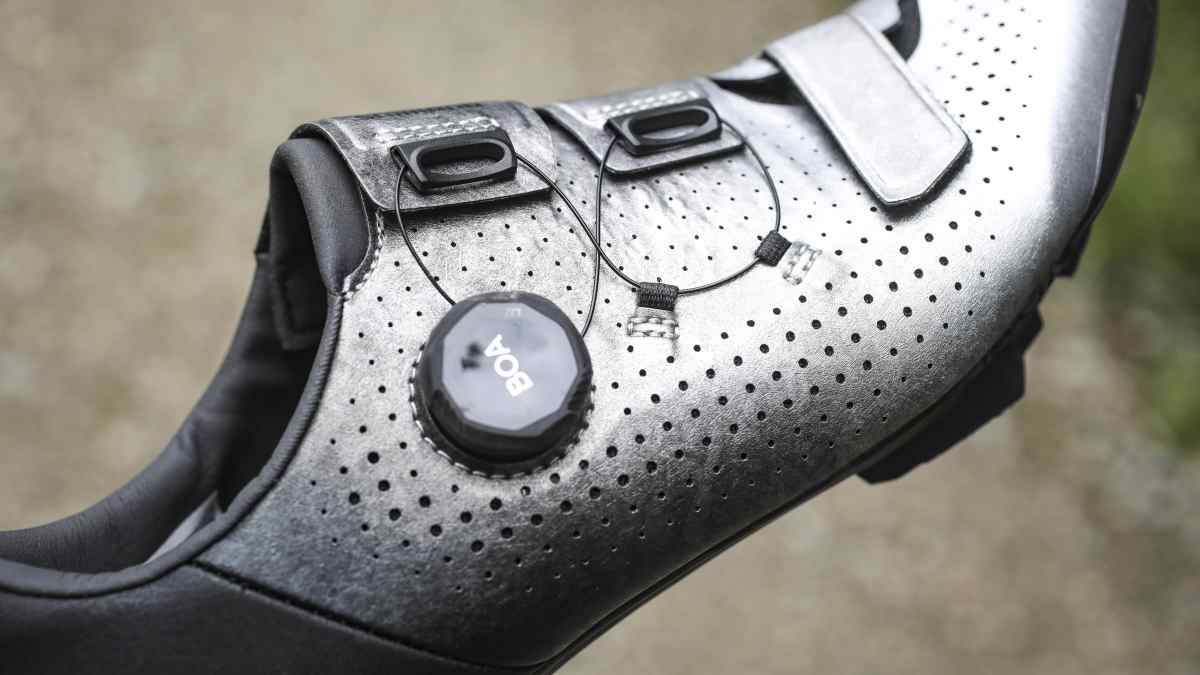
- Boa vs. laces: While twist locks (Boa) allow millimetre adjustment while riding, classic laces are making a comeback on gravel bikes. Why? They are uncomplicated, easy to replace and exude that irresistible retro adventurer charm.
- Protection: Good models protect the mechanics with covers or position them in such a way that contact with obstacles and dirt impact is minimised.
4. robustness: armour for the feet
A gravel shoe is a workhorse. It collides with stones, scrapes along branches and dips into puddles.
- The upper material: We pay attention to reinforced toe caps and abrasion-resistant heel areas. A good shoe doesn't look like a total loss after a season in the dirt, but wears its patina with pride.
- Climate management: The material must be breathable to let heat out, but at the same time water-repellent enough to ignore the first rain shower or morning dew.
The top 3 gravel shoes from our comparison test
Suplest XC/Gravel Performance - Test winner
- Price299 Euro >> available here
- Weight (size 46): 795 grams
- Sizes: 39-47; 42,5-44,5 half sizes
- Sole / StiffnessCarbon / 396 N/mm
- Made inItaly
- EquipmentTwo Boa swivel fasteners, wrap-around tongue, carbon sole, TPU reinforced toe and heel, Solestar insole, SUPtraction profile
- Fitnarrow and flat throughout; true to size

Evaluation & conclusion
| Category | Grade |
| Power transmission (35%) | 1,3 |
| Walk / Grip (25%) | 1,9 |
| Closure / Handling (25%) | 1,5 |
| Weight (15%) | 2,5 |
| BIKE NOTE | 1,7 |
With the new XC/Gravel Performance, Suplest delivers an extremely strong all-rounder for gravel races, marathons and fast trail tours. Despite the stiff carbon sole, the Swiss shoe combines decent running characteristics with high comfort and an excellent fit - only the flat heel needs to fit the foot. Our tip for fast bike and gravel adventures.
Mavic Cosmic Boa SPD - the price tip
- Price149 Euro >> available here
- Weight (size 46): 663 grams
- Sizes: 36-48 2/3 in 2/3 sizes
- Sole / StiffnessNylon glass fibre / 241 N/mm
- Made inItaly
- Equipmentinsole with memory foam, Boa L6 fastening, Velcro, seamless upper material
- Fitnarrow and flat on the instep throughout, rather short

Evaluation & conclusion
| Category | Grade |
| Power transmission (35%) | 2,3 |
| Walk / Grip (25%) | 2,9 |
| Closure / Handling (25%) | 1,9 |
| Weight (15%) | 1,5 |
| BIKE NOTE | 2,2 |
The gravel shoe from Mavic is clearly inspired by road bike shoes, as evidenced not only by the slim, pointed shape, but also the very narrow tread pattern with low grip studs. This makes pushing passages a balancing act. The Cosmic Boa SPD works much better on the pedals: it sits comfortably and can be adjusted to the foot using the Boa dial and Velcro fastener. The heel is also firmly enclosed. The fibreglass-reinforced sole offers a good compromise between power transmission and comfort and also has a clearly visible scale for cleat adjustment.
Shimano RX801 - the lightweight racer
- Price250 Euro >> at Rosebikes or Bike components available
- Weight (size 46): 634 grams
- Sizes: 38-48 / also in wide
- Sole / StiffnessCarbon / 367 N/mm
- Made inChina
- EquipmentBoa-Li2, Velcro fastening; enclosing tongue; replaceable pad; narrow profile sole; short pedal channel
- Fitnarrow and flat throughout, flat instep, true to size

Evaluation & conclusion
| Category | Grade |
| Power transmission (35%) | 1,5 |
| Walk / Grip (25%) | 3,6 |
| Closure / Handling (25%) | 1,4 |
| Weight (15%) | 1,0 |
| BIKE NOTE | 1,9 |
With the RX801, Shimano has a thoroughbred gravel racing shoe in its programme. Thanks to the thick carbon sole, extremely durable upper material and almost perfect fastening system, power is transferred to the pedals without loss. The other side of the coin: The Shimano is not a comfort miracle, and if you want to master longer pushing passages with it, you should have experience in running with high heels. However, as long as you stand on the pedals, the RX801 a top shoe for gravel sprints.

Stefan Frey
Editor