


In this article, we use so-called affiliate links. With every purchase through these links, we receive a commission from the merchant. All relevant referral links are marked with . Learn more.
Conclusion on the Giro Chamber TR
The Giro Chamber TR Impresses with a stiff sole, efficient power transfer and a secure grip on rough trails. The rear-set cleat position and the comfortable neoprene inner boot are clear plus points. The Giro has its weaknesses when it comes to toe and ankle protection, fit for high insteps, and ventilation. A strong trail and enduro boot, though it doesn’t quite measure up to a Shimano GE9. Stefan Frey, BIKE editor
Giro’s Chamber has been a mainstay in the gravity sector for years. Even during their numerous World Cup downhill victories, the pros were wearing the American brand’s shoes. The new Chamber TR is based on the well-known Chamber platform, but has been redesigned and optimised for trail riding.
From the downhill run to the trail
The basis remains the so-called tri-moulded DH platform, which is already used in the World Cup-proven Chamber models. The aim, however, was to reduce weight and improve ventilation without compromising the power transfer typical of gravity boots.
To this end, Giro has opted for a new microfibre upper with integrated mesh inserts. These are designed to improve air circulation whilst providing a more direct feel on the pedals.
BOA instead of laces
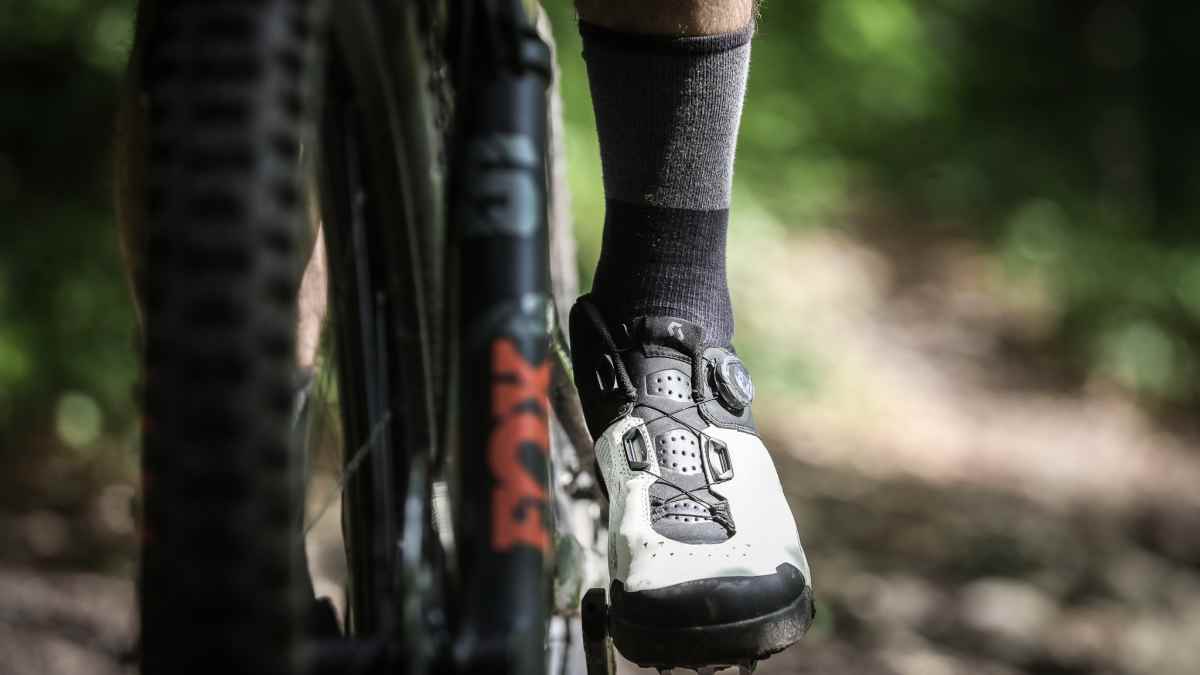
One of the most noticeable new features is the BOA system with a Li2 twist lock. Compared to traditional lacing systems, this allows you to adjust the fit quickly whilst on the move, in small increments – both forwards and backwards. In addition, a closed knitted cuff at the ankle is designed to keep small stones and dirt out of the shoe.

Greater freedom in cleat positioning
An exciting feature for gravity and enduro riders is the generous cleat area. The Chamber TR offers up to 38 millimetres of adjustment, allowing the cleats to be positioned particularly far back. On steep descents in particular, many riders prefer a more rearward pedal position to achieve greater stability on the bike.
Grip for running sections
For the outsole, Giro has opted for its proprietary Sensor Rubber. The rubber compound is designed to offer a balance between durability and grip. The package is reinforced by an EVA midsole, a TPU toe cap and a nylon/fibreglass sole plate.
Giro Chamber TR: Information & Price
- BOA Fit System with Li2 aluminium twist lock
- Microfibre upper with mesh ventilation
- Closed ankle cuff to prevent dirt from getting in
- Giro Sensor Rubber Outsole
- 38 mm cleat adjustment range
- Weight: 1022 grams (size 46)
- Price: 209.99 euros >> available here
In practice – just empty promises?
I enjoy tackling long climbs and then rewarding myself with a challenging descent – steep, rocky and uneven. What I need is a shoe with a stiff sole, a grippy tread and solid protection for my toes and ankles. A shoe like the Shimano GE9. Or perhaps the new Giro Chamber TR after all?
The downhill-inspired sole, at least, is as sturdy as an oak trunk; it really helps you make good progress uphill, and you gain altitude without losing too much energy. Downhill, you feel incredibly secure on the pedals. The cleat shaft, which is set slightly further back, helps you maintain a balanced, stable position on the pedals when riding downhill. The neoprene sock, instead of a traditional tongue, prevents pressure points and keeps dirt out – that’s brilliant. However, the toes and ankles are only moderately protected. The TPU reinforcement at the front of the shoe could have been a bit sturdier. Shimano’s competitor also offers significantly better protection around the ankles. On the Giro, the cuff ends just below the ankles.
One thing that stands out: the Chamber has a very low profile – not suitable for those with a high instep. The single twist fastening also has a drawback: the lacing is already tight at the back, whilst the front loop provides hardly any tension on the foot. An additional Velcro fastening would have been useful here. Like so many modern trail shoes, the Chamber TR is rather poorly ventilated, and on warm summer days in particular, it gets hot and sweaty inside the shoe. Incidentally, the GE9 doesn’t fare any better in this respect. In all other respects, however, the Shimano has the edge.


Stefan Frey
Editor