


Sunglasses for the wild side of your life
There are people who plan everything: the route, breaks, weather windows and the espresso afterwards. And then there are those who set off in the morning and end up somewhere in the evening.
Perhaps at a beach bar. Perhaps under the palm trees, where even time seems to slow down. Perhaps with a cold beer in your hand. Or perhaps on a mountain bike through the undergrowth, or with a finger tracing the sandstone of Saxon Switzerland.
The best days rarely go to plan. It’s precisely for days like these that DZBR Sunglasses. The motto fits: “Sunglasses for the wild side of your life.”
These glasses are meant to be neither a delicate fashion accessory nor a pure sports item. They aim to be both: casual enough for everyday wear, yet functional enough for physical activity. Glasses for people who, first thing in the morning, don’t yet know whether the day will end on a café terrace, at the bike park or on the rocks.
What good cycling glasses need to offer
When cycling, glasses don’t just protect your eyes from the sun. They also keep wind, dust, insects and flying stones out of your eyes. Anyone who’s ever had a fly fly into their eye whilst cycling at 30 km/h needs no further advice on which glasses to buy.

There are four key points:
Fit: The glasses must neither press against your face nor slip. It is particularly important that they work well with your helmet. If the arms of the glasses come into contact with the helmet shell or straps, even slight pressure can quickly turn into a full-blown headache.
Cover: Large lenses don’t just look sporty. They’re better at keeping out draughts and foreign particles. At the same time, there should be enough air circulating between the lens and your face.
Ventilation: Windows can mist up when driving uphill slowly, at traffic lights or in damp woodland air. Ventilation openings and high-quality coatings help to keep the windows clear.
UV protection: It’s not a matter of choice, but a necessity. Good-quality lenses reliably filter out UVA and UVB radiation. A dark tint alone is no guarantee of this – without an effective filter, it can actually damage your eyes.
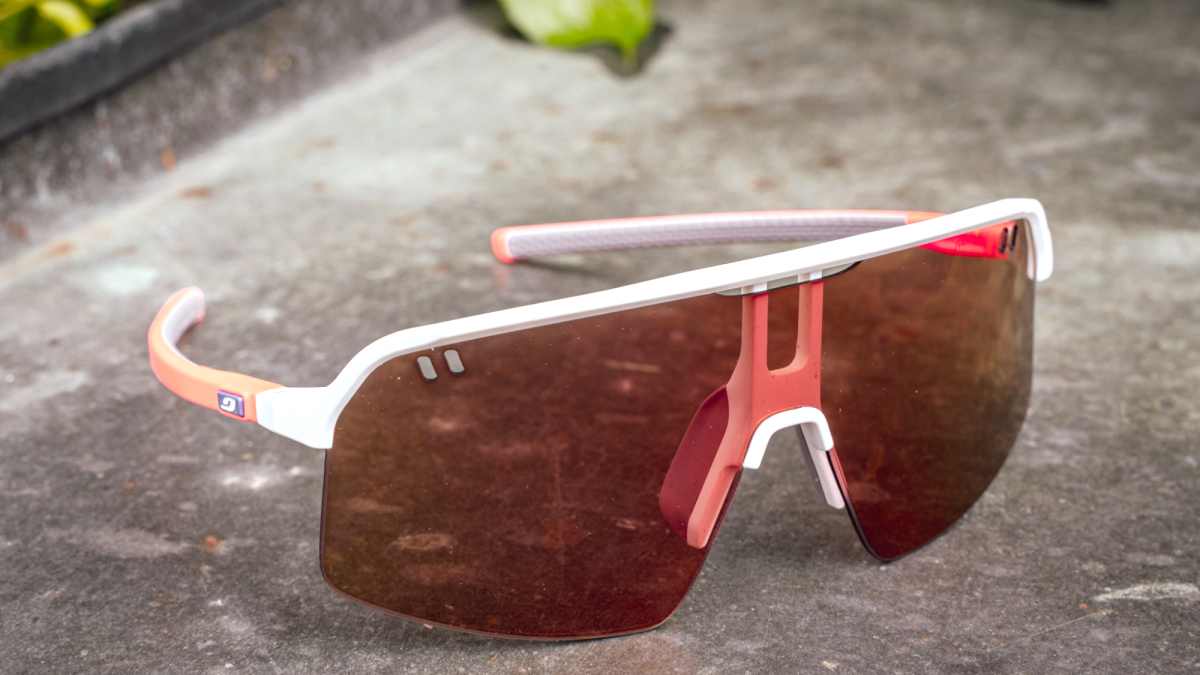
DZBR opts for large-format polycarbonate glazing with 100 per cent UV protection. Polycarbonate can be made thin and is easy to work with; at the same time, it is extremely impact-resistant and is therefore also used for safety glazing.
Lightweight construction for the face
The frame of a pair of sports glasses has to strike a difficult balance. It should be barely noticeable, yet it mustn’t break at the first fall or lose its shape in the summer heat.
DZBR uses the following for this purpose TR90, a high-performance plastic developed by the Swiss company EMS. The material is lightweight, flexible and robust. It gives way under stress without immediately giving in. This enhances comfort and makes the frame durable enough for everyday use, travel and sport.
Adjustable nose pads and customisable temples help to position the glasses correctly on your head and nose. That may sound like a minor detail, but it determines whether they start to annoy you after ten minutes or whether you’ve forgotten they’re there after three hours. Good sports glasses sit securely without being obtrusive.
The range currently comprises eight styles. Work is already underway on special women’s models. In terms of price, the glasses have a recommended retail price of 79.90 to 89.90 euros in the mid-range – well above the ‘internet bargain’ but far below many premium models.
What expensive glasses do better
The market ranges from glasses costing 15 euros to high-tech models costing more than 200 euros. The price difference is rarely down to the logo alone. Glasses tend to be more expensive mainly because of more sophisticated lenses, better coatings, more precise workmanship and complex tinting techniques.
This is particularly evident in photochromic lenses. They react to UV light: they darken in the sun and lighten again in the shade. This is particularly useful when mountain biking and gravel riding, when open stretches and dark woodland sections alternate constantly.
Lower-priced models often have the light-sensitive layer applied merely as a coating. They usually react more slowly, cover a narrower range of tints and may lose their effectiveness over time. In high-quality lenses, the photochromic substances are embedded in the material or protected between several layers. They react more quickly and are better protected against abrasion.
Premium glasses also often offer:
- a wider range, from almost clear to strongly tinted,
- fewer optical distortions,
- stronger contrasts,
- water- and dirt-repellent surfaces,
- greater scratch resistance,
- faster adaptation to changing light conditions.
That doesn’t mean that every cheap pair of glasses is poor quality. Even inexpensive polycarbonate models can offer reliable UV protection. If you mainly cycle on open roads in consistent light conditions, you don’t necessarily need a pair of high-precision lenses.
In the woods, it’s a different story. If photochromic lenses remain too dark for too long after moving from sunlight into shade, the energy-saving feature quickly turns into flying blind. Frequent drivers, mountain bikers and people with sensitive eyes therefore benefit more from high-quality lenses.
Shopping without the hassle of trying on glasses
Where possible, you should try on sports glasses whilst wearing your own helmet. Five simple tests will help you with this:
- Shaking one’s head: The glasses mustn’t slip.
- Putting on your helmet: The brackets and straps must not interfere with one another.
- Look down: The glasses should stay on your nose.
- Look to the side: The frame must not unnecessarily restrict the field of vision.
- Wear for a few minutes: Pressure marks rarely appear within the first ten seconds.
Also, do not rub the lenses dry with your cycling jersey. Dust acts like sandpaper. Rinse them first, then dry them with a clean microfibre cloth. Harsh cleaning products can damage coatings.
With prices under 90 euros, DZBR strikes a sensible balance: high-quality frame materials, sturdy polycarbonate lenses, an adjustable fit and a look that works even after your ride. These glasses don’t set out to dictate where the day takes you. They simply ensure you can see clearly whilst you’re out and about.
After all, plans are good. But taking a different path is often better.

Dimitri Lehner
Editor