


In this article, we use so-called affiliate links. With every purchase through these links, we receive a commission from the merchant. All relevant referral links are marked with . Learn more.
Crashes are part and parcel of mountain biking. The question isn’t whether you’ll go down at some point, but when. In a personal commentary, BIKE editor Stefan Frey explains why a pair of gloves is among the most important pieces of protective kit on a bike, and why the consequences of a crash often leave your palms feeling the effects for weeks afterwards.
Call me soft, old-school or out of fashion. I know that anyone who’s anyone these days goes cycling without gloves. Preferably in baggy jeans and a loose-fitting T-shirt, too. Dirt flies up in the bends, just like a hunting dog digging for a hare’s burrow. The tyres burp when you push through the banked bend with gusto. And without high-rise handlebars as high as those on Peter Fonda’s chopper, no descent is rideable anymore.
I’m sort of out of that scene. I wear performance kit, even bib shorts. I take bends without my rear wheel locking up, and my handlebars are lower than my saddle – no joke! That means I’ve got pressure where it’s needed in the bends, and I can keep riding up the climbs when the others have long since been pushing their high-rise bikes.
But what’s even more important is that I never cycle without gloves. Not even when the sun is beating down and my hands feel like they’re in an oven. Nor when it’s pouring with rain and I’ve already got webbed hands inside my gloves. And certainly not in winter, when my fingers hang from the handlebars like dead branches – that goes without saying. Why? I was painfully reminded of this again today, because this time the ‘never’ has to be preceded by an ‘actually’.

I’ve forgotten my gloves, damn it!
My colleague Laurin and I set off last night for an overnight stay at the summit, and I realised as soon as we started climbing: Blimey, I’d forgotten my gloves. So I sweated my way up the steep climb with damp, clammy hands and no grip on the handlebars. But that was still just about bearable.
Then this morning: I’d been really looking forward to this absolutely magnificent trail – a picture-perfect Alpine descent. Steep and rocky at the top, a root-filled nightmare through the woods at the bottom. But right at the first narrow section, my knuckles were already scraping against the dwarf pines. Ouch. Barely any grip on the handlebars on the steep sections, little suspension travel over the root-strewn section, and then, in a hairpin bend, I was too lazy to shift my weight.
You can picture it: the handlebars buckle. Your mind already knows what’s coming, whilst your body slowly plummets towards the ground like a felled tree trunk. What happens just before the impact is probably what you’d call an instinctive reaction. The arms shoot forward and the hands desperately try to break the fall, like a lorry driver bracing himself against his rolling lorry. It’s of little use – it just causes pain.
What happens next has been well known to accident and emergency doctors for decades: the palms of the hands absorb a large proportion of the impact energy. At the same time, gravel, stones or tarmac act like sandpaper on the skin. This often results in painful grazes, cuts or bruises – just as happened to me today.
Anyone who has ever tried to work, drive a car or even just hold a coffee cup with cut palms knows just how much such seemingly minor injuries can disrupt everyday life.
The perspective of accident and emergency medicine
“In cycling and mountain-biking accidents, we regularly see grazes and soft-tissue injuries to the hands. This is usually caused by the natural reflex to break the fall by putting out one’s arms,” explains a trauma surgeon. From a medical point of view, three aspects in particular are problematic:
1. Grazes are rarely harmless
Many cyclists underestimate the risk posed by grazes. However, soil, dust and fine particles of stone often penetrate deep into the injured tissue. If the wounds are not cleaned thoroughly, there is a risk of infection or a prolonged recovery.
2. Hands take longer to heal than expected
Our hands are constantly on the move. Grasping, carrying, typing, steering: hardly any other part of the body is used so intensively. That is precisely why even superficial injuries can cause prolonged pain and delay healing.
3. More serious injuries are often underestimated
As well as skin injuries, severe falls can also affect ligaments, tendons or the wrist. If a cyclist falls onto a hard surface with their hand outstretched, sprains and fractures are not uncommon.
The most common hand injuries following a mountain bike crash
Abrasions (‘road rash’)
By far the most common type of injury.
Consequences:
- severe pain
- impaired grip function
- Risk of infection
- potential scarring
Cuts and lacerations
Particularly on stony trails or when coming into contact with branches.
Consequences:
- deep tissue damage
- possible nerve or tendon injuries
- medical care required
Bruises and contusions
These are caused by a direct impact with the ground.
Consequences:
- Swelling
- Bruises
- Pain on pressure
Ligament injuries and sprains
This is typical when the hands are twisted during a fall.
Consequences:
- Instability
- Loss of strength
- longer breaks from training
Fractures of the carpal bones and wrist
The most serious of the common injuries.
Consequences:
- A plaster cast or an operation
- a break from sport lasting several weeks
- potential loss of function
What gloves actually do
Of course, gloves do not prevent broken bones. Anyone who crashes into a rock at high speed will not be able to defy the laws of physics, even with the most expensive models. Nevertheless, they fulfil several important functions:
Protection against abrasion
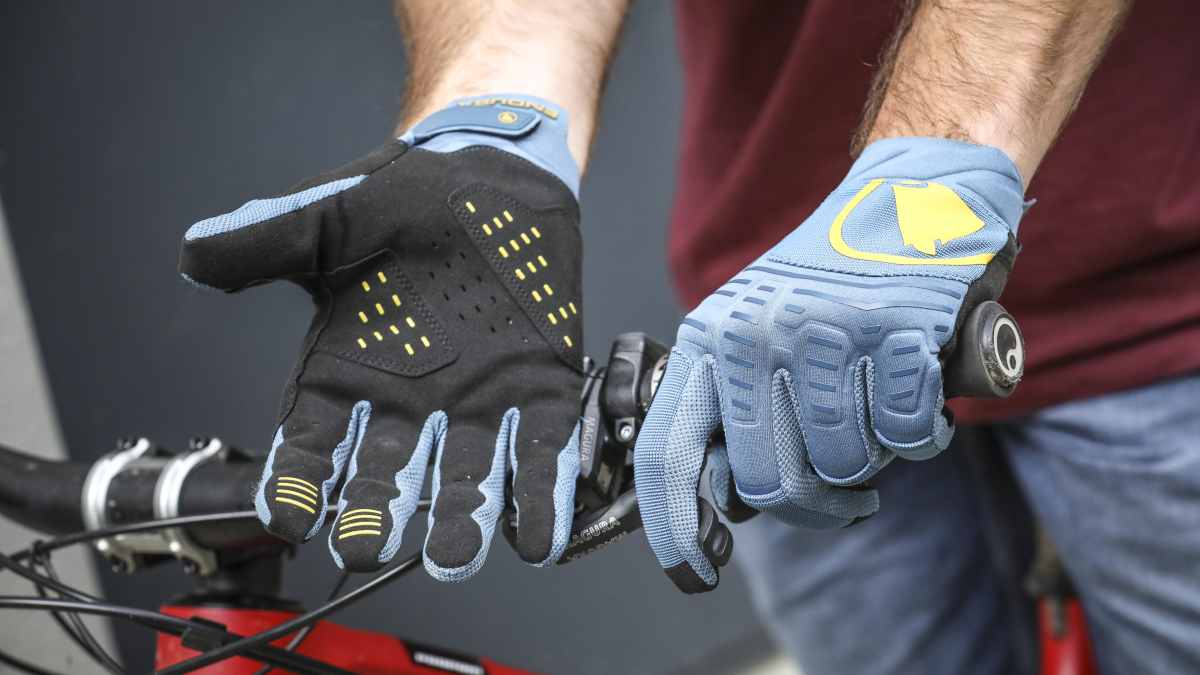
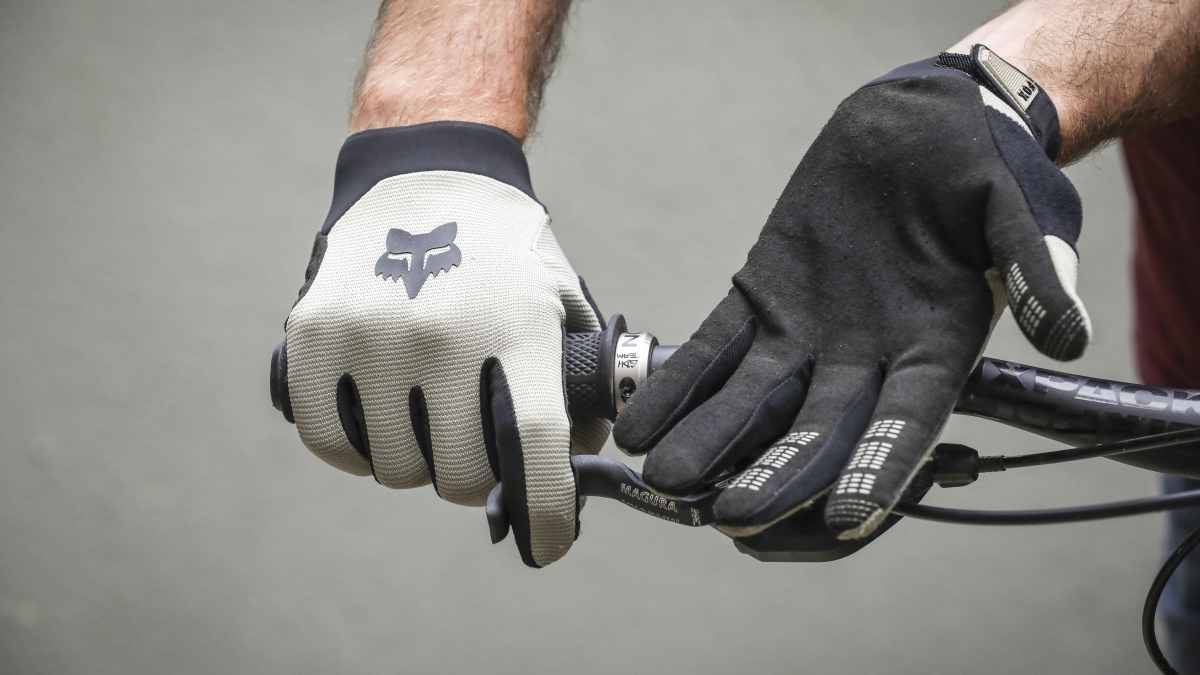
The sturdy palm provides an extra layer of protection between the skin and the ground. As a result, grazes are often much less severe. There are even models that feature protectors such as D3O or similar materials on the palm, offering additional protection.
Greater control at the handlebars
Sweat, rain and vibrations can reduce your grip. Modern MTB gloves improve control and reduce the risk of your hands slipping off the handlebars.
Protection against falling branches and falling rocks
On narrow single tracks in particular, long-fingered gloves protect your knuckles and the backs of your hands from contact with vegetation and flying stones.
Less fatigue
Padded models reduce pressure peaks and vibrations. As a result, hands and forearms often remain able to perform for longer on long rides.
Why many experienced mountain bikers never ride without gloves
Anyone who rides trails regularly develops a different awareness of risk over time. Not because you’re constantly falling over, but because you’ve experienced just how quickly a small mistake can have major consequences. Interestingly, many long-time riders don’t report serious broken bones, but rather the most annoying injuries of all: grazed palms. These are injuries that are often relatively minor from a medical point of view, but which have a massive impact on everyday life. That’s precisely why, at enduro races, bike park days or alpine tours, you hardly ever see experienced riders without gloves.
Immediate steps to take straight after a fall
If you have fallen onto your hands, you should first check whether it is just a superficial injury or whether ligaments, tendons or bones may be affected.
1. Take a quick breath and check your hands
Check both hands for:
- severe pain
- Malpositions of the fingers or wrist
- Swelling
- open wounds
- Numbness or tingling
- reduced mobility
If you can move your fingers and wrist normally, that’s a good sign. However, pain does not rule out a serious injury.
2. Clean grazes
If the skin is cracked:
- Carefully remove any coarse dirt
- Rinse the wound with clean water or saline solution
- Carefully remove the small stones
- disinfect afterwards
- Apply a sterile wound dressing
Dirt, sand and small stones often get into the skin, particularly during mountain bike crashes. If these are not removed, they can cause inflammation.
3. Cooling
For bruises and swelling:
- Use a cold pack or a cold flannel
- Never place directly on the skin
- chill for about 10 to 20 minutes
- Repeat several times if necessary
This can help to reduce pain and swelling.
4. Reduce stress
If your wrist or fingers are aching:
- Do not drive any further for the time being
- Be gentle with your hand
- Do not carry heavy objects
- Elevate the affected area if there is significant swelling
When you should see a doctor
Have your hand examined by a doctor if:
- severe pain persists
- the wrist swells up quickly
- Fingers or wrists do not move as they normally should
- Numbness may occur
- there is a visible misalignment
- the pain does not subside after a few hours
- you have pain when pressure is applied to the thumb side of your wrist
A scaphoid fracture, in particular, is often overlooked following cycling accidents. The symptoms often seem harmless at first, but can have serious consequences if left untreated.
What many motorcyclists get wrong
Many cyclists get back on their bikes after a fall and only realise hours later that they have injured their wrist. Adrenaline can initially mask the pain quite effectively.
My advice as a mountain biker: if your hand is noticeably painful or swollen after a fall, it’s better to have it checked once too often than once too little. A week’s enforced break is usually more pleasant than several months with a neglected hand injury.

Stefan Frey
Editor