


In this article, we use so-called affiliate links. With every purchase through these links, we receive a commission from the merchant. All relevant referral links are marked with . Learn more.
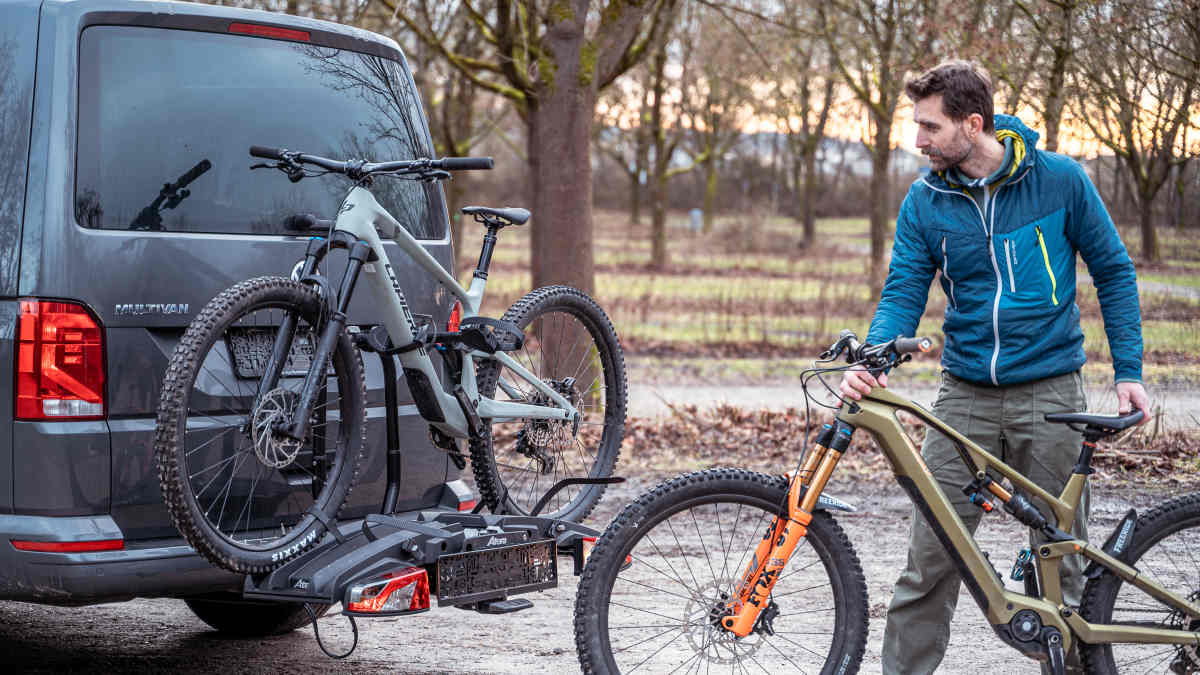
The market for bike racks has changed dramatically in recent years. Whilst roof racks used to be the norm, today systems for Tow bar (AHK) the market, with a share of 70 to 75 per cent – and the trend is upwards. The reasons for this are easy to explain: unlike roof racks, towbar racks can be fitted in just a few simple steps and are particularly useful for e-bikes with their low loading height, or for making it easier to manoeuvre them onto ramps. As they are transported in the slipstream of the vehicle, fuel consumption increases only minimally.
Tailgate supports have always been regarded as something of a rarity and were used almost exclusively on the VW Bus or other vans. However, with the way tailgates are constructed today, this issue has effectively been resolved.
But how much does a bike rack cost, and how do you find the right model? We’ll use the different price ranges to show you what you can expect for your budget and offer buying recommendations for suitable brands.
Entry-level to solid mid-range: functional and sensible
Westfalia Bikelander Classic bike carrier
Price: approx. 500 euros >> available here

The Bikelander Classic is a classic bike carrier without any technical frills, but with a well-thought-out basic design. It is aimed at users who transport their bikes a few times a year and value solid workmanship. Its rails and lights can be folded away for transport, and the retaining bar can also be folded down.
In a nutshell:
- suitable for two bicycles, with the option to expand to three
- Maximum payload 60 kg (suitable for e-bikes within the towbar load limit)
- foldable, collapsible
- conventional lighting, robust mechanics
A rack for practical people, which requires little attention in everyday use and is perfectly adequate for lighter e-bikes.
Eufab Pro BC 2+
Price: 669 euros >> available here
With a wingspan like a condor, the Eufab can carry even the longest wheelbases. The adjustable wheel clamps are brilliant. All the straps are metal-reinforced, rubberised and can accommodate even fat tyres or bulky down tubes. As well as the solid build quality, the long clamping lever, the carrying handle and the fold-down function – which makes it suitable for buses – are particularly impressive. A minor drawback: the bracket offers few clamping positions, and adjusting the clamps is a bit fiddly. Some parts are a bit sharp-edged.

In a nutshell:
- for two bicycles, can be extended to three
- 60 kg maximum load capacity
- can be folded down using a foot pedal, suitable for use on buses
- handy ratchet-style gripping arms, good carrying handle
- sturdy, not particularly delicate, but durable
A bike rack for frequent cyclists who aren’t looking for a designer item, but rather a reliable companion.
A high-quality mid-range bike rack: designed with everyday practicality in mind
Atera Strada E-bike
Price: 680 euros >> Available here at a reduced price
The Strada has often been a welcome addition to our tests. The e-bike version marks the transition to the more comfortable mid-range category. Its wide rail spacing, easy folding mechanism and secure locking system make it a popular choice for e-bike riders on a modest budget.
In a nutshell:
- two bicycles, expandable to three
- Load capacity up to 60 kg (67.9 kg with 3 bikes)
- wide track spacing (approx. 23 cm)
- Weight: 14.3 kg
- a good balance between weight, stability and price
A reliable all-rounder for cyclists who regularly ride e-bikes but don’t need a premium model. For models with particularly wide tyres or long wheelbases, the Strada is also available in an XL version.
Uebler i21 Z60
Price: 1,362 euros >> Available here at a reduced price
The simple design of the i21 Z60 saves weight and ensures a minimal storage footprint. Nevertheless, the Uebler bike carrier is sturdy and well-built. It slots effortlessly onto the towbar and locks into place by folding down the rails – clever! Thanks to the wide bracket and easily adjustable clamps, the Uebler can accommodate even complex frame shapes. There’s just not quite enough clearance for very long wheelbases – longer straps are available as an option. The tapered rails fit almost all tyre widths. Made in Germany and finished to a high standard.

In brief:
- very low weight (approx. 14 kg)
- 60 kg payload with sufficient drawbar load
- excellent folded dimensions
- particularly easy to use
Ideal for users with a tight towbar load limit or limited space. The Z90 version of the bike rack features an increased tilt angle, making it suitable for the VW Bus and similar vehicles.
Premium bike rack: maximum convenience, plenty of capacity
Thule Epos (2 or 3)
It is not without reason that the Epos is regarded as the benchmark. Its build quality, ease of use and suitability for e-bikes are all of a very high standard. The price is particularly justified when travelling or for frequent use. The design of the mounting arms between the rails is particularly clever, making the Epos exceptionally easy to load. The flexible mounting arms allow for a wide range of clamping positions and, thanks to the ratchet system and rubber protectors, are gentle on carbon frames. The Epos is also available with the ParkSecure reverse parking system as an option.

In a nutshell:
- high load capacity (up to 60 kg)
- Excellent stability, even for bulky frames
- very easy to fold down
- foldable, optional accessories (ramp, bag, lock)
A carrier for anyone who regularly transports heavy e-bikes and wants to make as few compromises as possible.
How do you make the right decision?
It is not necessarily the most expensive carrier that is the best, but rather the one that suits your own usage profile. If you only travel occasionally, you do not need high-end mechanics. However, if you regularly load heavy e-bikes, you will noticeably benefit from comfort, stability and a well-thought-out design.
The most sensible investment is usually to be found where Towbar load, bike weight and ease of use in everyday life all fit together seamlessly – not where the list of features is the longest.
A bicycle towbar carrier is a practical item, not a status symbol. The models listed here show that there is a suitable solution for almost every use case. Anyone who honestly assesses how often, how heavy and how comfortably they need to transport their bikes will find a carrier amongst the current range on the market that will work reliably for many years – and that is exactly what it’s all about.

Stefan Frey
Editor