


G-One RS Pro and G-One RX Pro: Schwalbe announces 32-inch tyres for gravel bikes
Josh Welz
· 21.09.2026


Schwalbe is launching its first 32-inch gravel tyres: the G-One RS Pro and G-One RX Pro. The technology promises benefits on rough terrain, but is still in the early stages of market development.
Our verdict on Schwalbe’s 32-inch launch
Schwalbe’s G-One RS Pro and RX Pro tyres make the 32-inch format a tangible reality in the gravel market for the first time. The tyres deliver on a credible performance promise, but remain part of an overall system that is still in its infancy. Whether this format catches on will depend not only on racing successes, but also, and in particular, on the component suppliers.
Schwalbe is expanding its range of gravel tyres to include a size that has, until now, mainly been seen on prototypes, bespoke frames and in the odd race. The G-One RS Pro and the G-One RX Pro are set to be available from specialist retailers from April 2027, in sizes 50-686 and 55-686 respectively. Matching inner tubes have also been announced.
This move comes at a time when 32-inch wheels are attracting significant attention in the gravel sector. However, the size is not yet an established standard. Tyres, wheels, forks and frames must be redeveloped and coordinated as an integrated system. The 32-inch trend is therefore still in its infancy, particularly when it comes to gravel bikes.

Two profiles, a new format
With the G-One RS Pro and G-One RX Pro, Schwalbe is bringing two well-known gravel tyre profiles to the new wheel size. The RS Pro is designed for fast, rolling conditions, whilst the RX Pro is aimed at varied and more challenging terrain.
Schwalbe has not yet provided any details regarding weight, carcass construction, rubber compound, tubeless approvals or recommended inner rim widths. This underlines how early the development stage is: the tyre is not simply another size, but part of a new system. But it seems the tyre manufacturer from the Bergisches Land region wants to stake its claim at an early stage.
Not yet an industry standard
The designation 686 refers to the rim seat diameter and thus represents a significant step beyond the 622 rim commonly used in gravel cycling. As the outer diameter increases, so too do the demands placed on the suspension and frame design.
The sizing notation requires some explanation: gravel bikes with 622 rims are classified as 28 or 29-inch, depending on the tyre width. A 32-inch bike, on the other hand, has an actually larger rim seat diameter of 686 millimetres.
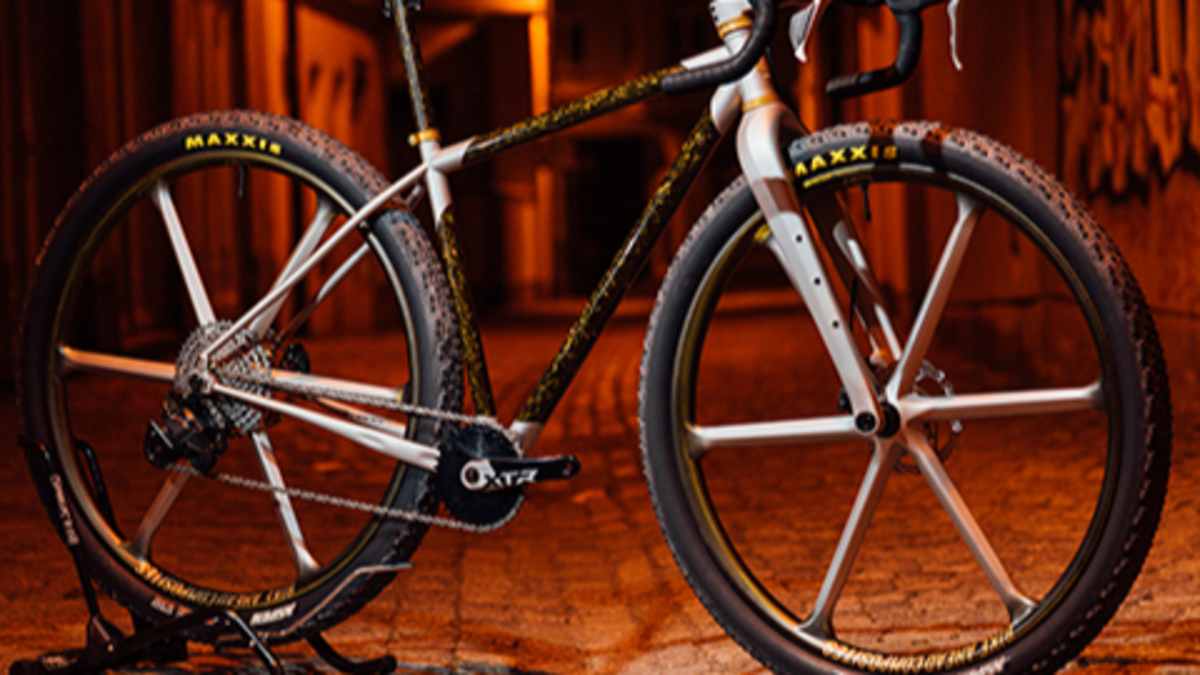
At the 2026 Unbound Gravel, Robin Gemperle won the 563-kilometre XL race on a Scott prototype fitted with a 50-millimetre-wide 32-inch G-One RX prototype. The German rider Leon Kaiser also competed in the high-calibre field 226ERS UCI Gravel World Series-He also rode to victory in the Girona race on a 32-inch gravel bike. This is a relevant stress test for the concept, but it is no substitute for broad market validation.
Schwalbe expects the first 32-inch gravel bikes to hit the market as production models by the start of autumn 2026 (and as an OEM supplier, they should certainly know this for a fact). Production-ready tyres will follow some time later, in April 2027. So far, 32-inch gravel frame sets and custom bikes are only available sporadically from niche manufacturers.
What the larger diameter is supposed to achieve
The main argument in favour of 32-inch wheels is their roll-over performance. A larger wheel makes flatter contact with stones, roots and washouts. This is said to result in less sudden deceleration and a smoother ride on rough terrain. Particularly on long, fast gravel sections, this provides greater stability, a greater sense of safety, better traction and greater comfort.
On the other hand, there are design-related drawbacks. 32-inch wheels do not fit on existing gravel bikes. Manufacturers must, amongst other things, rebalance the chainstays, fork height, head tube angle, bottom bracket position and stack height. This becomes particularly difficult with small frame sizes.
The rotating mass also increases. Larger rims, longer spokes and bulky tyres mean more weight, which in turn affects acceleration and agility. It is therefore a matter of weighing up the pros and cons.
For retailers and customers alike, the supply of parts remains a concern. Spare tyres, inner tubes, wheels and suitable forks must be available before a system suitable for everyday use can be developed. Several manufacturers are working on components, but the market is still in its early stages of development.
Key information at a glance
- Models: Schwalbe G-One RS Pro and G-One RX Pro.
- Sizes: 50-686 and 55-686, i.e. 50 and 55 millimetres wide respectively, on 686 rims.
- Availability: Available from specialist retailers from April 2027, with matching hoses included.
- Orientation: RS Pro for fast gravel rides, RX Pro for more challenging terrain

Josh Welz
Editor-in-Chief