


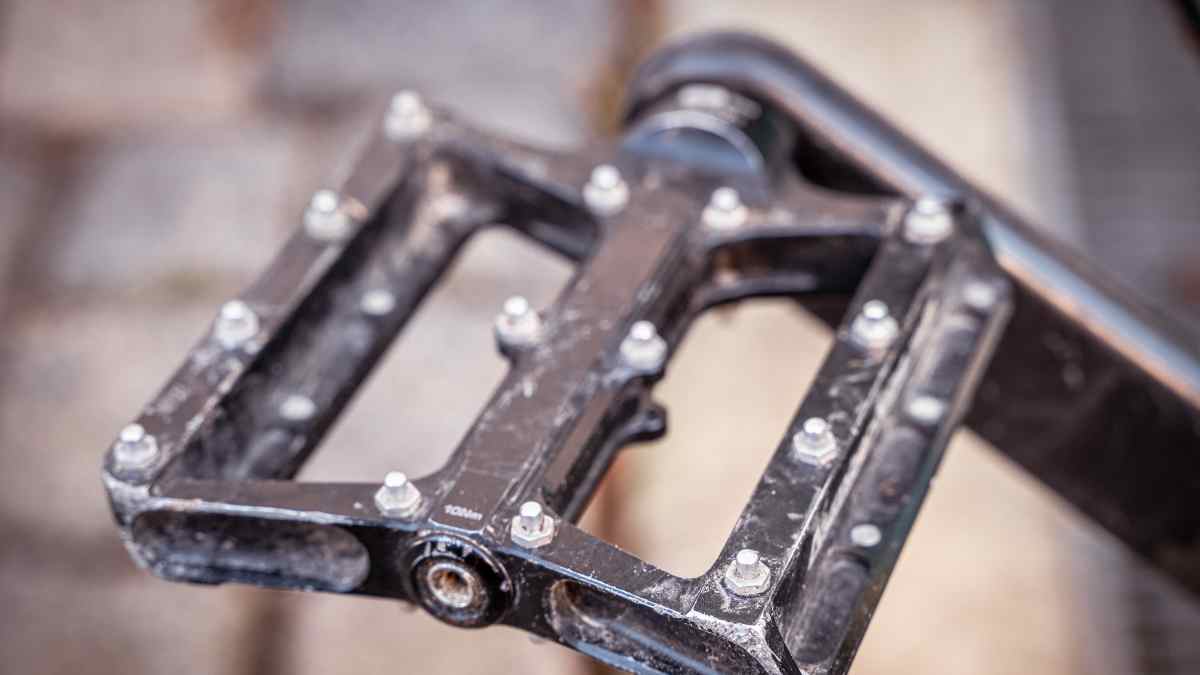
While the competition is still sticking to ball bearings, Sixpack Racing is taking a different approach. The Millenium 4.0 relies on plain bearing technology - a challenge to established design principles in pedal construction. Two Igus J3 plain bearings per pedal replace the classic ball bearings. The manufacturer promises smooth running with minimal maintenance - but above all a very low weight and an ultra-flat design for more ground clearance.
The aluminium platform measures 115 mm in length and 105 mm in width, giving it a pleasantly large footprint. However, with a height of 12 mm in the centre and 14 mm at the edge, the Millenium 4.0 clearly undercuts many competitor products. Shimano Saint pedals, for example, measure 16 mm, Hope F20 is 15 mm. The flat design should guarantee maximum ground clearance in technical passages - a decisive advantage when rocks and roots dictate the line.
Sixpack Racing Millenium 4.0 - Info & Price
- MaterialAluminium
- Warehouse2x Igus J3 plain bearings per pedal
- Axlehardened CrMo axle
- Pins: 9 per page
- Platformconcave
- Floor spaceL 115 mm x W 105 m
- Height12 mm centre, 14 mm edge
- Weight375 g (Pro Version) / 405 grams (Standard)
- Price149.95 Euro (Pro Version) / 119.95 Euro (Standard)
Igus J3 plain bearing instead of balls
The decision against ball bearings is radical. Sixpack Racing relies on Igus J3 plain bearings, which, according to the manufacturer, offer 45 per cent more bearing contact surface than the in-house competitor, the Kamikaze PA pedal. More contact surface means better load distribution. The hardened CrMo axle can be opened with a 3 mm Allen key. No special tools are required, as is the case with many Shimano or Crankbrothers pedals. This makes maintenance on the trail or in the workshop easier.

While ball bearings quickly suffer from dirt and moisture, Igus bearings are said to react more robustly. Plain bearings are considered to be low-maintenance and insensitive to dirt - an advantage for gravity riders who expose their pedals to extreme conditions.
Pin layout with 9 pins per side
A total of 9 pins per side are distributed across the concave platform. The pin arrangement follows an anatomical layout designed to position the foot naturally. The concave shape presses the foot into a defined position and is also intended to generate greater grip. The narrower Q-factor is intended to provide a more direct pedalling feel.
Pro version with milled finish
The Millenium 4.0 is available in two versions. The Pro version has a milled finish, which saves weight. This means that the new six-pack pedal weighs just 375 grams. For comparison: The Crankbrothers Stamp 11 for 300 euros weighs 331 grams with a titanium axle (click here for the test of 7 high-end flat pedals). Most other gravity pedals weigh well over 400 grams.
The standard version of the Millenium does without the milling process and weighs correspondingly more - 405 grams according to the manufacturer. Both versions use identical materials and bearings. The price difference remains manageable at 149.95 to 119.95 euros.
The opinion of the editorial team
Dispensing with ball bearings is a clever move and not only saves weight in the end. Above all, the height of the pedal can be significantly reduced by using plain bearings - and this in turn pays off in more ground clearance. A large platform pedal that doesn't get stuck on every root in the terrain is something we all want. In addition, the feet are pleasantly close to the cranks, which in combination with the flat design should lead to a pleasantly direct riding experience. With a weight of just 375 grams for the pair, the new Millenium 4.0 are also very light for the price. We will find out in the practical test whether the bearings can withstand gravity use in the long term.



Stefan Frey
Editor