


In this article, we use so-called affiliate links. With every purchase through these links, we receive a commission from the merchant. All relevant referral links are marked with . Learn more.
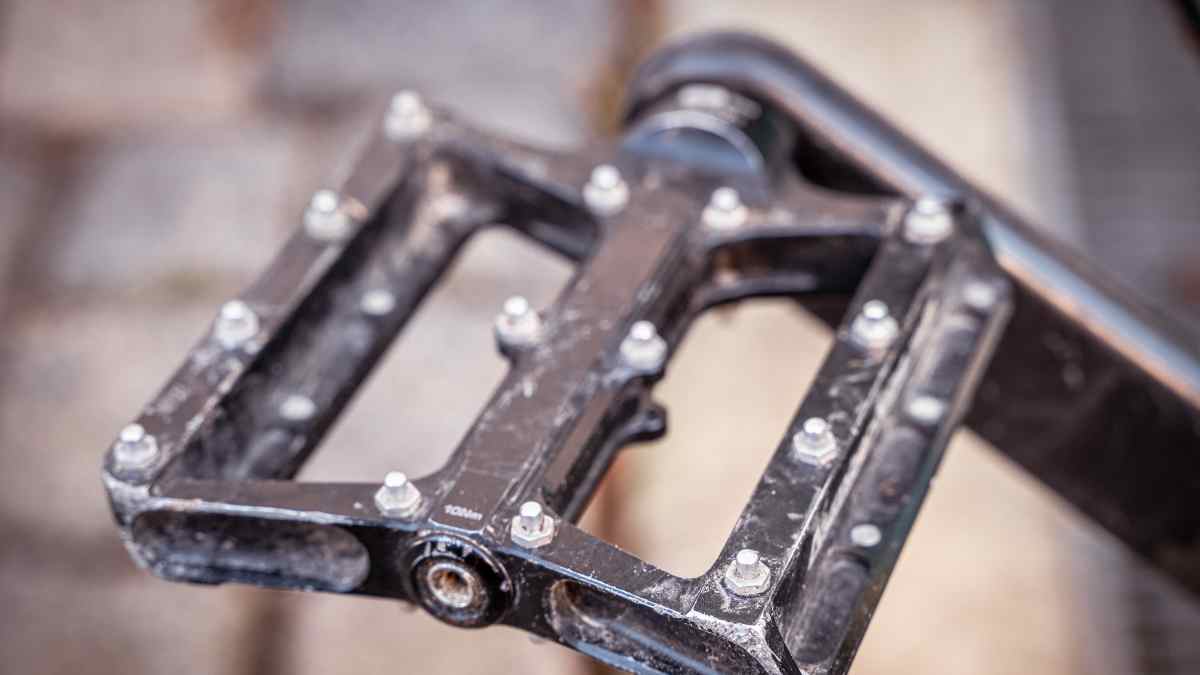
While many competitors continue to rely on ball bearings, Sixpack Racing is taking a different direction with the Millenium 4.0 flat pedal. The pedal consistently utilises plain bearing technology. Two Igus J3 plain bearings are used per pedal, completely replacing the usual ball bearings.
According to the manufacturer, this should ensure smooth running with low maintenance requirements - but above all a very low weight and a low overall height, which enables additional ground clearance.
The pedal is available in two versions: Millenium 4.0 (€119.95) and Millenium 4.0 Pro (€149.95) - each in two colours (Raw and Midnight Black).
The platform is generously dimensioned, but not excessively large. The aluminium pedals are 115 mm long and 105 mm wide. With a height of 12 mm in the centre and 14 mm at the edge, the Millenium 4.0 is significantly flatter than many competitor models.
For comparison: Shimano Saint pedals come in at 16 mm, the Hope F20 at 15 mm. The low height should ensure maximum ground clearance in technical passages - a clear advantage when rocks and roots dictate the ideal line.
Flat pedal uses plain bearings instead of balls
By moving away from ball bearings in favour of the two Igus J3 plain bearings per axle, the manufacturer claims to offer 45 percent more bearing contact surface than its in-house counterpart, the Kamikaze PA pedal. A larger contact surface ensures better load distribution.
The hardened CrMo axle can be easily opened with a 3 mm Allen key - special tools, such as those required for many Shimano or Crankbrothers pedals, are no longer necessary. This makes maintenance much less complicated, both on the trail and in the workshop.
While ball bearings often quickly reach their limits when exposed to dirt and moisture, Igus bearings are said to be much more resistant. Plain bearings are generally considered to be low-maintenance and less susceptible to contamination - a clear advantage for gravity riders who regularly use their pedals in tough conditions.
Sixpack Racing Millenium 4.0 - Info & Price
- MaterialAluminium
- Warehouse2x Igus J3 plain bearings per pedal
- Axishardened CrMo axle
- Pins: 9 per page
- Platformconcave
- Floor spaceL 115 mm x W 105 m
- Height12 mm centre, 14 mm edge
- Weight375 g (Pro Version) / 405 grams (Standard)
- Price149.95 Euro (Pro Version) / 119.95 Euro (Standard)

Practical test: How the new Sixpack Millenium Racing 4.0 Pro pedals ride
The nine pins on each side are narrow and bite deeply into the sole of the shoe - you can feel this from the very first few metres. If you want to reposition your foot, you first have to take the weight off it and then reposition it. Grip: Check! The pedal size felt comfortable with shoe size 46. Compared to the competition, it is large, but not excessively so.
Admittedly: We were unable to test the most important criterion in our initial riding impressions - namely durability. That's what matters with a pedal. Does it lose pins? Do the bearings remain tight or is there play between the pedal body and axle?
Either way, the first impression of the Sixpack Millenium 4.0 Pro is good. The weight of 370 grams per pair is very low compared to other flat pedals. The price is also solid - there are significantly more expensive models in this weight class. Check out the comparison in the link below.



Laurin Lehner
Editor
