


Conclusion
There is no one-size-fits-all ‘perfect’ cockpit. Whilst racers sit stretched out and low on their bikes for maximum efficiency, downhill riders need wide handlebars and short stems for uncompromising control on the trail. Your own body shape always sets the limit: if you can grip the handlebars comfortably and ergonomically, you’ll ultimately ride faster, more safely and with greater endurance.
The mountain bike cockpit is the primary interface between rider and bike. If you get it wrong here, you’re not only compromising your riding performance, but also risking sore wrists, burning forearms or a stiff neck. Getting the components perfectly set up is a complex process requiring precision down to the millimetre, determined by individual body measurements, personal riding position and intended use. Only when all these factors work in harmony do rider and bike merge into a single, controllable unit.
Handlebar width: comfort and control
The ideal handlebar width is determined primarily by the rider’s shoulder width, arm length and overall height. A tried-and-tested method for determining your individual base width is the push-up position: Assume a push-up position in which you feel most stable and powerful, and have the distance between the outer edges of your hands measured. A rider with a broader build will therefore require a very different base width to a smaller, more petite person. A rider with longer arms may also opt for a wider Leker than a rider with shorter arms. Generally speaking, modern mountain bike handlebars now range from 720 to 800 millimetres.

The area of application sets the direction:
- Cross-Country (XC) Race: Narrower handlebars, ranging from 720 to 740 millimetres, are the norm here. They ensure a streamlined, aerodynamic upper-body position, transfer a lot of weight to the front wheel for steep climbs, and make it easier to manoeuvre through narrow forest paths and dense fields of riders.
- Tour / All-Mountain: A good balance between comfort and control is usually found at around 760 millimetres. On long rides, this width reduces strain on the shoulder muscles whilst still providing sufficient leverage on moderately difficult terrain.
- Enduro & Downhill: Maximum leverage and optimum control on rough terrain are essential here. Widths of 780 to 800 millimetres are now the standard for keeping the bike on course with precision at high speeds, over massive compressions and across rough scree slopes.
Beware of exaggerations: Handlebars that are too wide cause the arms to be overextended, pull the upper body unnaturally far forwards and restrict elbow movement. Paradoxically, this results in a loss of momentum, makes it harder to swerve round obstacles and causes you to tire much more quickly on long descents.
Bend and Sweep: Ergonomic Geometry in Detail
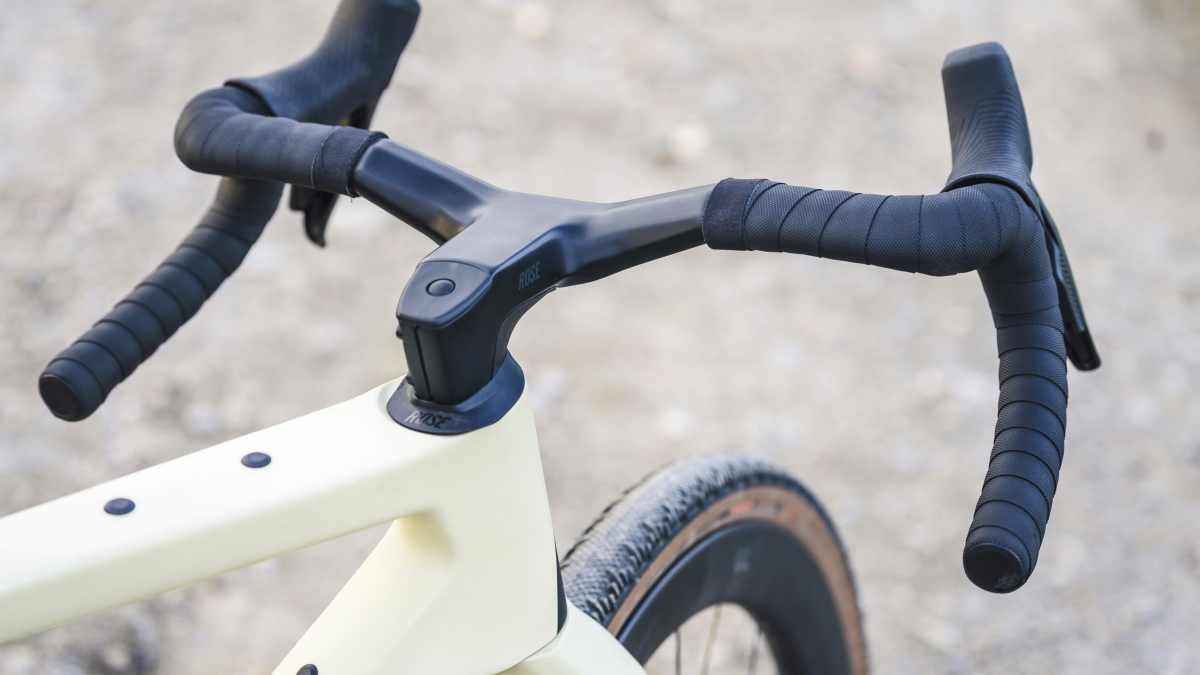
A handlebar is almost never a perfectly straight tube. To accommodate the natural bone and joint structures of the human body, it has a three-dimensional curve. This complex geometry is broken down into three factors: rise, backsweep and upsweep. Each of these nuances alters the angle at which the hand meets the grip.

- The backsweep (backward curve): This value is given in degrees and usually ranges between 5° and 12°. It is the most important factor in ensuring pain-free wrists. The wider the handlebars, the greater the backsweep tends to need to be. When you stretch your arms out wide, your palms automatically tilt at an angle. A handlebar with sufficient backsweep accommodates this natural angle. If the backsweep is too small, the wrists are overextended outwards. This results in compressed nerve channels, which manifest as numb fingers (numbness in the little and ring fingers) or chronic tendon irritation.
- The upsweep (upward curve): It describes the angle at which the ends of the handlebars rise upwards from the centre, usually between 4° and 6°. The up-sweep works in tandem with the back-sweep to ensure that the load is distributed evenly across the entire palm, rather than exerting pressure solely on the outer edges. It also promotes an active riding position with the elbows angled slightly outwards – the so-called ‘attack position’.
- The Rise (The Bend/Height): The rise, measured in millimetres (ranging from 0 mm for flat bars to 40 mm or more for high-rise handlebars), indicates how much higher the grips are in relation to the clamp on the stem. It is a key factor in determining the height of the entire front end (the effective stack). Handlebars with a high rise provide a more upright riding position and reduce pressure on the front end, which suits a looser, more playful riding style – such as freeriding. It also takes the strain off the wrists on steep gradients and reduces the feeling of being thrown over the handlebars on steep descents. XC racers opt for minimal rise values to sit low and generate maximum pressure on the front end.
Stem length and angle: The lever arm
The stem acts as a mechanical lever arm and influences how quickly and directly the rider’s steering inputs are transmitted to the front wheel. At the same time, together with the frame’s top tube length, it determines the reach and thus how stretched out or hunched the riding position is. The overall length of the upper body and the individual arm length are the decisive anatomical criteria here.
- Long stems (60 to 90 mm, often with a negative angle): This combination is typical of the XC sector. A long stem positions the rider far forward, optimises lung function by opening up the chest, shifts the centre of gravity forwards and puts the rider in an aerodynamically favourable riding position on flat sections. A negative angle pushes the cockpit even further towards the ground. This ensures that the front wheel remains firmly in contact with the ground, even on extremely steep inclines. As a result, steering behaviour on uphill sections is smoother and more stable.
- Short stems (30 to 50 mm, usually with an angle of 0° to 6°): They are the norm in downhill-oriented enduro and downhill cycling. A short stem brings the handlebars close to the rider’s centre of gravity. As a result, the hands rotate almost directly on the fork steerer’s axis of rotation, resulting in razor-sharp, agile and playful handling. Every slight shift in weight is immediately translated into movement. Furthermore, the short lever makes it easier to shift your body weight behind the saddle in a flash on steep terrain, without having to fully extend your arms.
The Law of Balance
If you want to optimise your cockpit, you should always change just one parameter at a time. If you change several parameters simultaneously, it is difficult to pinpoint which change is responsible for which effect. An important biomechanical principle is that if you use a wider handlebar, your hands move further outwards, which automatically pulls your upper body further forwards. To compensate for this change in position, the stem must be shortened accordingly (rule of thumb: approx. 10 mm shorter stem for every 20 mm increase in handlebar width), so that the basic balance on the mountain bike is maintained.

Josh Welz
Editor-in-Chief