


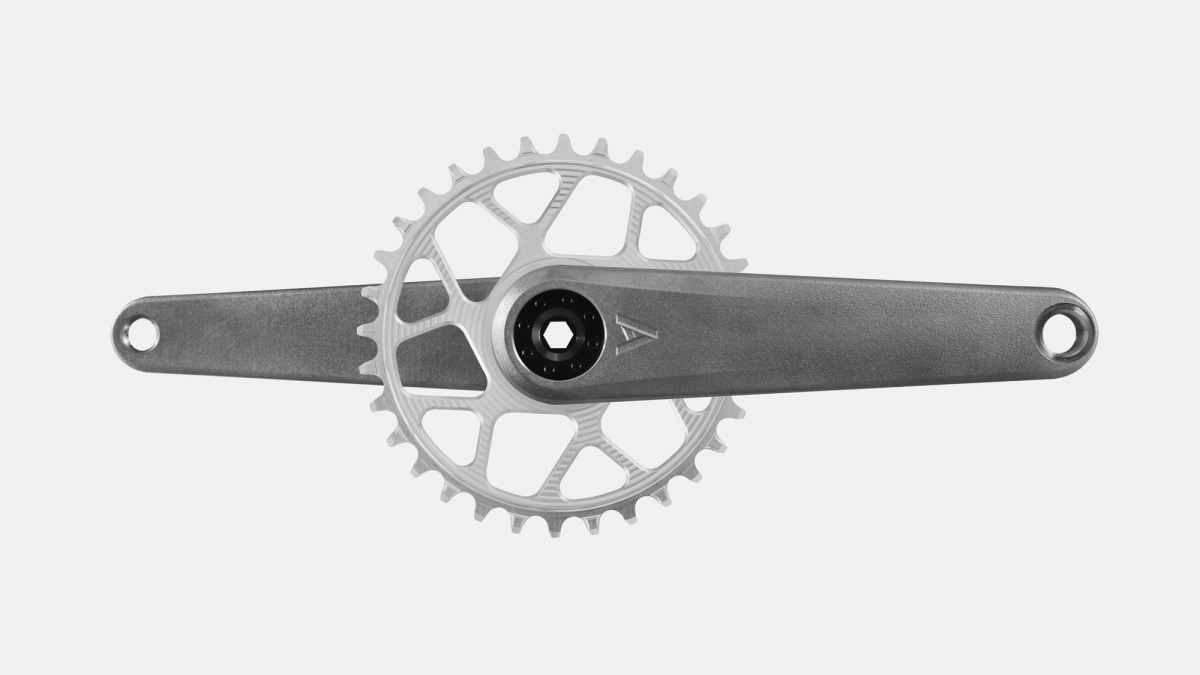
In the world of bicycle components, titanium is the stuff dreams are made of. But while the material is often celebrated for its aesthetics, the new collaboration between Brunk Industries, White Industries and Moots goes far beyond looks. This crank is the result of a technological synergy rarely seen in the bike industry.
Exceptional alliance
This project originated at Brunk Industries' high-precision manufacturing facility in Lake Geneva, Wisconsin. For over 60 years, Brunk has been a world-leading specialist in metal forming, with components typically found in aerospace and highly complex medical devices. The company has mastered titanium forming techniques that go far beyond what is common in the bicycle industry.
But a medical technology specialist does not yet build a bicycle crank. This is where two legends came into play: White Industries from California, which has epitomised the finest CNC milling skills and sophisticated drivetrain solutions since 1978, and Moots from Colorado, which has been regarded as the "welding gods" of titanium frame construction for over 35 years. Together they have created a product in which the specific strengths of each partner are emphasised.
Forming instead of machining
The centrepiece of the innovation lies in the manufacturing process of the crank arms. While conventional high-end cranks are usually milled from solid blocks (CNC) or laminated from carbon layups, this cooperation utilises Brunk Industries' forming technology. Titanium is moulded under extreme pressure. This process positively changes the microstructure of the metal and ensures material compression in the highly stressed zones.

The result should be a crank that is not only extremely light - at approx. 420 grams for the 165 mm arm including shaft - but above all should have unrivalled fatigue resistance. Titanium is known for its "memory" and flexibility, but according to the manufacturer, the targeted shaping has achieved a stiffness that leaves nothing to be desired even in tough MTB use.
The role of Moots and White Industries
After the arms have been moulded at Brunk, they travel to Moots in Steamboat Springs. There they are finally welded and finished. Moots brings decades of experience to the table to ensure that each weld is not only visually pleasing, but also perfectly preserves the structural integrity of the titanium structure.
White Industries, on the other hand, is responsible for the "brain" of the system: the system architecture. The aim was to create a modular system. Thanks to various shaft options, the crank can easily switch between a narrow road/gravel setup (68/86.5 mm housing width) and a wide MTB setup (73/91.5 mm housing width). The system is also flexible when it comes to the chainline: from 47.5 mm for gravel use to the modern 55 mm MTB standard, everything is possible.
Individualisation and compatibility
Special attention was paid to future viability. The crank uses an 8-hole interface for the chainring. This not only makes it compatible with modern direct mount chainrings, but also with standard power metre spiders. A decisive factor for the target group of performance-orientated riders.
The visual design differs depending on the provider:
- White Industries T30: The technical look dominates here. The pull-off caps of the crank are available in eight different anodised colours (pink, gold, black, blue, red, bronze, purple or silver), which allows for perfect coordination with other White components such as hubs or headsets.
- Moots Ti Cranks: This version impresses with more discreet branding with lasered logos. Particularly interesting for owners of a Moots frame: premium finishes are offered that are precisely matched to the Moots frame graphics to create a seamless "titanium look" on the entire bike.
Technical data in detail
- Material: High-precision titanium (moulded, welded and CNC-machined)
- Origin: 100% Made in USA (Wisconsin, California, Colorado)
- Weight: 432g (170mm, incl. shaft)
- Crank lengths: 165 mm, 170 mm, 175 mm
- Shaft diameter: 29 mm (DUB-compatible) or 30 mm available
- Bottom bracket compatibility: 68/86.5 mm (Road/Gravel) or 73/91.5 mm (MTB)
- Chain line: 47.5 mm or 55 mm (depending on spindle configuration)
- Chainring interface: 8-bolt (compatible with direct mount and power metres)
- Colours (caps): Pink, gold, black, blue, red, bronze, purple, silver
- Price (RRP): 1349.00 Dollar
Conclusion: for the connoisseur
The titanium crank from Moots and White Industries is an investment for the ages. At a time when components are often technically obsolete or worn out after two seasons, the titanium triumvirate from the USA focuses on indestructibility and timeless design. A statement against the throwaway mentality and in favour of American engineering - but at a price.

Josh Welz
Editor-in-Chief