


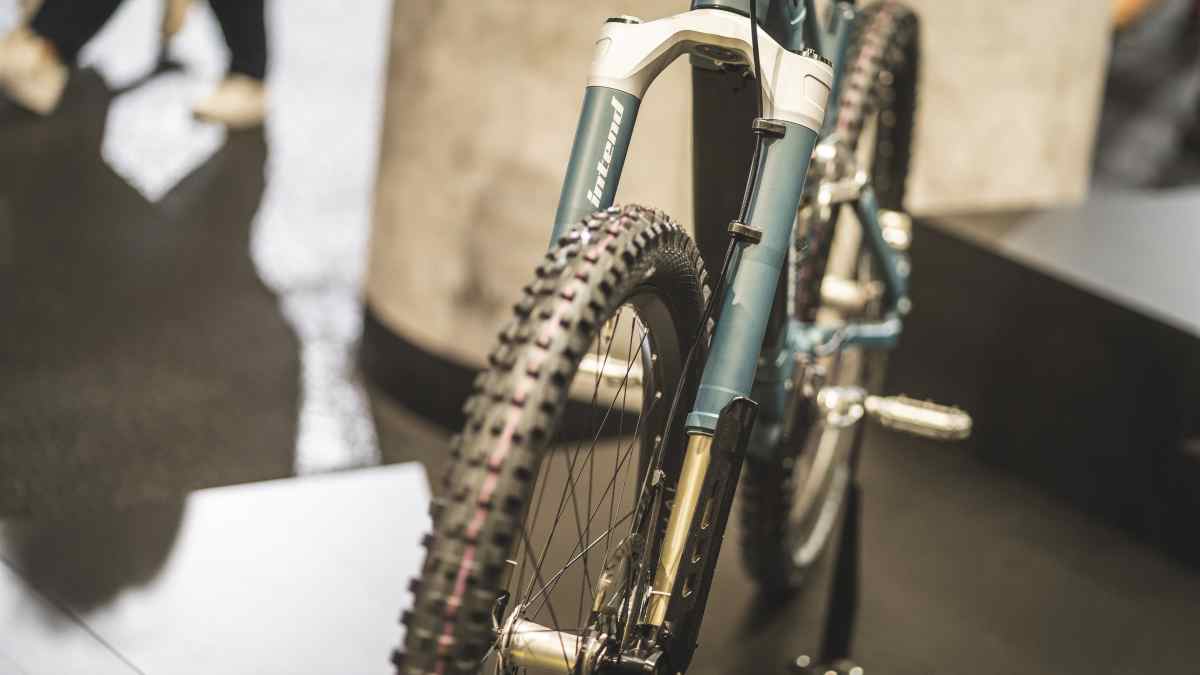
Manitou Dorado Pro Silver Edition: Exclusive, limited-edition World Cup fork fitted to the Nicolai R20 MGU AON
Stefan Frey
· 22.08.2026


From the World Cup course to a production bike
Over the past few seasons, the silver Dorado has become a real hallmark of AON racing bikes. Ever since its successful World Cup appearances with Reece Wilson, the fork has enjoyed almost cult status within the gravity scene.
However, the Silver Edition is more than just a special paint finish. Beneath its exclusive appearance lies the latest Dorado Pro platform, including the technologies developed in collaboration with the riders at AON Racing and tested at the very highest World Cup level.
The collaboration between Manitou, Nicolai , Gamux and AON Racing It takes a holistic approach. Rather than developing individual components in isolation, the bike is viewed as a complete performance system.
Conclusion from the editor’s perspective
Personally, I’m fascinated by these sort of exclusive team editions, because I can’t think of anything more boring than an off-the-shelf bike. The whole concept of customisation is virtually dead in today’s e-MTB world. It’s a shame. What I find exciting is that the Dorado Pro Silver Edition is not simply a special colour, but a visible symbol of a multi-year development programme between Manitou, Gamux, Nicolai and AON Racing. Technically, the Dorado remains one of the most interesting downhill forks on the market. The combination of upside-down architecture, the IRT system and the TPC+ damper deliberately takes a different approach to many of its competitors. The fact that, as the owner of the new Silver Edition, you either have to ride for AON Racing or get your hands on one of the strictly limited-edition Nicolai R20 MGU AON Edition bikes does make the Manitou all the more exclusive – but at the same time renders it unattractive to the vast majority of cyclists out there. Stefan Frey, BIKE editor
The centrepiece: the Dorado 37
The Silver Edition is based on the current Dorado 37. The familiar one remains a characteristic feature Upside-down construction with 37-millimetre stanchions. Whilst many manufacturers in the gravity segment opt for traditional suspension forks, Manitou has remained committed to the inverted design for decades. The aim is to achieve maximum sensitivity whilst ensuring a smooth ride and consistent responsiveness.

Dorado Air Spring with variable travel adjustment
For the suspension, Manitou relies on the latest Dorado Air Spring System. It features an integrated equalisation valve between the positive and negative air chambers, which is designed to ensure the fork operates particularly smoothly throughout its entire travel and to prevent ‘dead’ zones within the stroke. The travel can be adjusted to 180, 190 or 200 millimetres without the need for additional tuning kits. This means the fork covers virtually the entire range of modern downhill and bike park riding.
IRT technology for greater flexibility in assessment
In addition, the Silver Edition features the well-known Infinite Rate Tune (IRT)-system. This is a second, separately adjustable air chamber which primarily affects the middle and final stages of the suspension travel. The advantage:
- lower main chamber pressure is possible
- responsive behaviour to small impacts
- more support in the mid-travel range
- greater compression reserve at the end of the suspension travel
This system has been one of the Dorado platform’s key differentiators for years.
TPC+ dampers and hydraulic bottom-out protection
For the suspension, Manitou uses the latest TPC+ cartridge. The system operates depending on speed and suspension travel. Minor bumps are absorbed with minimal damping, whilst additional support is provided as the load increases. Particularly useful for challenging routes: the integrated Hydraulic Bottom-Out System.
In the final 30 millimetres of travel, the damping is significantly increased to provide better control over hard impacts, big jumps and rough rocky sections. In addition, a spring-assisted IFP piston is designed to prevent cavitation – that is, pressure fluctuations within the system – and to maintain consistent damping performance even on long downhill sections.
Upside-down forks: advantages and disadvantages
The Dorado differs from traditional downhill forks primarily in its Upside-down construction method.
Advantages
Improved responsiveness
As the heavier components are positioned closer to the frame and the unsprung mass is reduced, upside-down forks often respond more sensitively to small bumps.
More consistent lubrication
Thanks to the inverted design, lubrication and oil are constantly present in the area of the plain bearings and seals. This can improve responsiveness, particularly on long descents.
Controlled flex characteristics
Compared with extremely stiff double-crown forks, upside-down models often offer slightly more controlled torsional flexibility. This allows the front wheel to generate more traction on rough terrain.
Disadvantages
More stringent design requirements
Achieving the desired balance between stiffness and flexibility is more difficult than with conventional designs.
More complex manufacturing
Upside-down forks are technically more complex and are therefore usually more expensive to develop and manufacture.
An unusual driving experience
Some riders prefer the more direct steering feel of conventional designs. The slightly greater inherent dynamism of upside-down systems is not to everyone’s taste.
A bike as your ticket
However, the real distinguishing feature remains its availability. The Dorado Pro Silver Edition will, for the time being, be available exclusively on Nicolai R20 MGU AON Edition will be available. Production numbers are expected to be extremely low. This means the fork will remain one of the most exclusive products on the current gravity market.
Manitou Dorado Pro Silver Edition – Key facts
- Exclusive Silver Edition of the Dorado 37
- So far, it has only been used by AON Racing
- Upside-down double-bridge fork
- 37 mm chassis
- Dorado Air Spring
- Suspension travel: 180 / 190 / 200 mm
- IRT auxiliary air chamber
- Sealed TPC+ cartridge
- Hydraulic Bottom Out
- Spring-assisted IFP
- Developed in collaboration with AON Racing and GAMUX
- Available exclusively on the Nicolai R20 MGU AON Edition
Conclusion from the editor’s perspective
Personally, I’m fascinated by these exclusive team editions, because I can’t think of anything more boring than an off-the-shelf bike. The whole concept of customisation is all but dead in today’s e-MTB world. It’s a shame. What I find exciting is that the Dorado Pro Silver Edition is not simply a special colour, but a visible symbol of a multi-year development programme between Manitou, Gamux, Nicolai and AON Racing.
Technically, the Dorado remains one of the most interesting downhill forks on the market. The combination of upside-down architecture, the IRT system and the TPC+ damper deliberately takes a different approach to many of its competitors. The fact that, as the owner of the new Silver Edition, you either have to ride for AON Racing or get your hands on one of the strictly limited-edition Nicolai R20 MGU AON Edition bikes does make the Manitou all the more exclusive – but at the same time renders it unattractive to the vast majority of cyclists out there. Stefan Frey, BIKE editor

Stefan Frey
Editor