


Anyone buying a new wheel or replacing their brake discs will, sooner or later, be faced with a fundamental decision: Centre Lock or 6-hole? Both systems serve the same purpose – securely attaching the brake disc to the hub. The differences in braking performance, fitting, maintenance, compatibility and weight are minor or non-existent.
If you buy a complete bike, you rarely have the freedom to choose between Centre Lock or 6-hole brake disc mounting. You take what you’re given. But if you’re retrofitting, you’re faced with a decision. Many hub manufacturers now offer both standards. First, the good news: there is no noticeable difference in braking power between the two standards. What matters far more are the brake disc, brake pads, brake caliper and the tuning of the entire system. Nevertheless, it’s worth taking a closer look at the respective advantages and disadvantages of the Centre Lock and 6-hole brake standards.
Conclusion
Let’s be honest: how often do you actually change a brake disc? Centre-lock or 6-hole is more a matter of personal preference and principle. The differences between the systems lie mainly in the fitting process, rather than in performance. Personally, I prefer the 6-hole standard, as I always have a 25 Torx to hand, unlike the Centre Lock tool. - Jan Timmermann, BIKE editor
6-hole: the universal classic
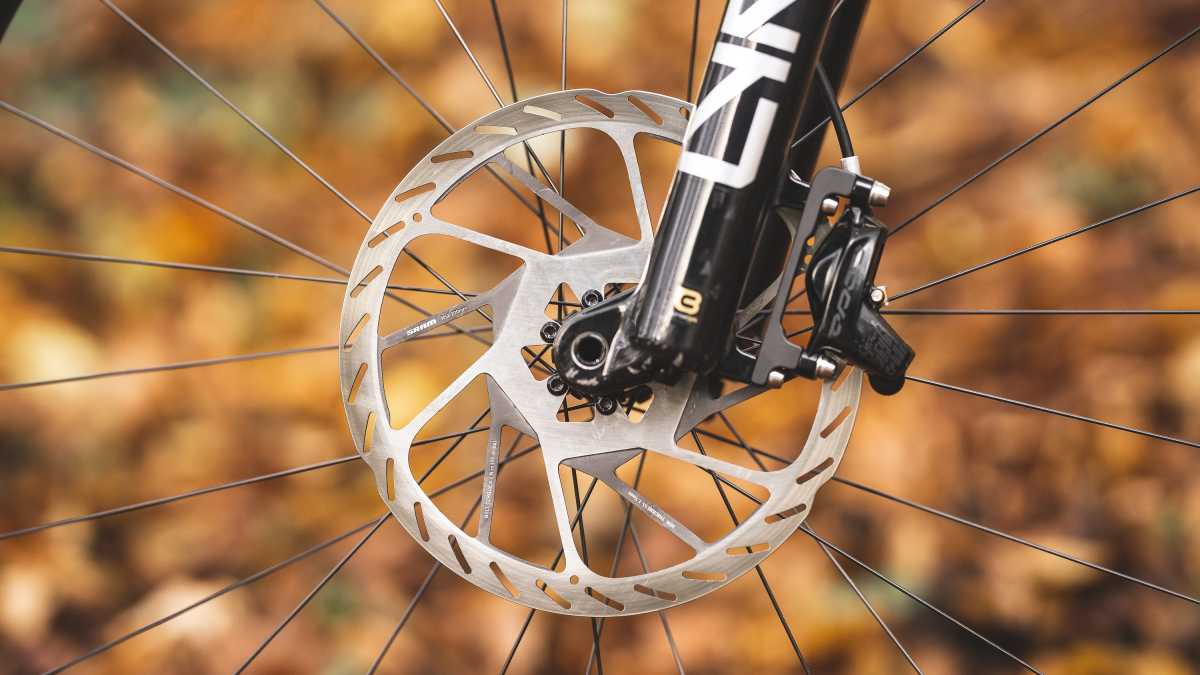
The 6-hole mount (International Standard, or IS for short) has been the established industry standard for many years. The brake disc is secured to the hub with six Torx bolts and is compatible with almost all manufacturers. The system continues to enjoy great popularity, particularly in the mountain bike sector. Virtually every manufacturer offers suitable brake discs – ranging from affordable entry-level models to high-quality two-piece racing discs or particularly robust models designed for extra braking power.

Advantages
- Extremely high compatibility across virtually all manufacturers
- A wide selection of brake discs across all price and quality ranges
- A Torx T25 tool is sufficient for assembly
- Ideal for riders who want to mix and match different components
Disadvantages
- Assembly and disassembly take a little longer, as six screws need to be tightened.
- The bolts should be tightened to the specified torque and in a criss-cross pattern. This means that changing the discs frequently takes longer.
Centerlock – Shimano’s clever solution
In the early 2000s, Shimano developed an alternative mounting system called Centre Lock. Instead of six bolts, the brake disc sits on a toothed rim on the hub and is secured simply with a lock ring. The main advantage is the speed of installation. Anyone who frequently changes wheels or brake discs – for example, in competitive cycling or when using multiple sets of wheels – saves time as a result. Today, CentreLock is particularly common on road bikes and gravel bikes.
Advantages
- Very quick assembly and disassembly: just one locking ring instead of six screws
- Reduced risk of uneven tensioning
- Particularly convenient when changing wheels frequently
Disadvantages
- A special tool is required for the lock ring
- even though many manufacturers now offer compatible products: the choice is slightly more limited when it comes to specialised brake discs
Differences in weight and stiffness
In practice, differences in weight resulting from the brake disc standard are of little significance. Depending on the disc model, there may be a difference of a few grams; however, this depends far more on the design of the brake disc than on the mounting system. Nor are there any demonstrable advantages of one system over the other in terms of rigidity or braking performance. The actual braking performance is not affected by either standard. Modern brake discs are available in both Centre Lock and 6-hole versions and offer high thermal stability.
A question of philosophy
The debate over ‘Centre Lock or 6-hole’ is often heated – but from a technical point of view, the two systems differ far less than many people realise. The 6-hole system offers maximum compatibility, a vast range of products and easy access to spare parts. Centre-lock impresses with its quick installation, clean design and convenient disc replacement. In short: anyone already using one of these two standards has little reason to switch.
When buying new, it is ultimately not so much the technology as your preferred wheel system and intended use that matter. If you already own Centre Lock hubs, you can also easily use an adapter to fit a 6-hole brake disc. The reverse – fitting a Centre Lock disc to a 6-hole hub – is, however, practically impossible. If you want maximum flexibility in the long term, a classic 6-hole hub therefore offers a slightly more versatile option.

Jan Timmermann
Editor