


Among bike manufacturers and industry insiders, 32-inch gravel bikes are the talk of the town. Until now, gravel bikes – inspired by fast road bikes – have typically been fitted with 28-inch wheels. Now, however, more and more models are being fitted with wider tyre clearance, allowing them to accommodate the 29-inch standard familiar from mountain bikes. To be clear: the actual rim size on 28-inch and 29-inch gravel bikes is the same. The term ‘29-inch’ is only used once a certain tyre width is reached, as this determines the outer diameter of the wheel. A 54-millimetre gravel tyre, for example, corresponds to the measurement 29 by 2.1 inches.
Now, even larger tyres – 32-inch ones – are coming into the picture. Is this just the next stage of a marketing coup? Apparently not, as even in professional sport, 32-inch gravel bikes are enjoying their first successes: Robin Gemperle recently won the world’s most prestigious gravel race (Unbound Gravel 2026) on his 32-inch prototype from Scott. What are the pros and cons of this new wheel size on a gravel bike? We’re taking a deep dive into 32-inch wheels and looking at the physics!
Conclusion
32-inch gravel bikes are here to stay, full stop! I’ve already tried out the new wheel size and I’m convinced: on a gravel bike in particular, these giant wheels make sense on many types of terrain. If manufacturers can now also get to grips with weight, stability, aerodynamics and availability, 32-inch gravel bikes will be hard to beat. - Jan Timmermann, BIKE editor
The advantages of 32-inch gravel bikes
1. Improved rollover behaviour
It is the most frequently cited and probably the most important argument in favour of 32-inch bikes: they roll better. The term ‘rolling performance’ describes how easily or with difficulty a vehicle rolls over obstacles. In the case of a gravel bike, these obstacles can include ruts and stones, but also simply potholes. The science is clear on this point: the larger the diameter of a wheel, the better its rolling characteristics. Anyone who has ever ridden on the small wheels of a city scooter knows how abruptly even the tiniest obstacles can bring the ride to a halt.

The forward momentum of 32-inch gravel wheels is less hindered by edges than that of a 28-inch gravel bike. In other words: the larger wheels fall into fewer potholes, get stuck less often and roll more smoothly over kerbs overall. This means your riding flow is less disrupted and you can maintain your speed for longer on uneven terrain. This can save the rider energy, particularly on long rides. The fact that larger wheels lower the rider’s centre of gravity in relation to the axle height further improves the bike’s rolling behaviour, as the gravel bike is more likely to be pushed over obstacles from behind rather than being forced against them.
2. Greater traction, lower rolling resistance
Until now, 32-inch gravel tyres have only been available in widths of 2.1 or 2.4 inches. This corresponds to a tyre width of 53 or 60 millimetres respectively. To date, most gravel bike manufacturers have been fitting tyres around 45 millimetres wide. It is a common misconception: wide tyres do not have more rolling resistance, but less. Whilst narrow tyres take on an elongated, oval shape when in contact with the ground, the so-called contact patch on wide tyres is rounder. The braking lever arm in the direction of travel is shorter with a round contact patch than with an oval one. 32-inch gravel bikes have a large tyre contact patch – not because of the larger wheel diameter, but because of their wide tyres – and therefore have lower rolling resistance.
At the same time, the larger contact patch also means more grip and, consequently, more traction. This term refers to a tyre’s ability to convert the rider’s power into forward motion without spinning. 32-inch tyres provide more tread contact with the ground. Compared with a 29 by 2.4-inch tyre, the contact patch of a 32 by 2.4-inch tyre is the same size but has a different shape, which provides extra grip.
Thanks to their superior traction, 32-inch gravel bikes convert pedalling effort into forward momentum with less loss of speed. This is particularly noticeable on extremely steep climbs, for example. According to our measurements, a 32-inch wheel requires seven per cent less power than a 29er to tackle the same climb in the same time. 32-inch gravel bikes are therefore more efficient. As an added bonus, they offer greater safety when riding downhill thanks to their superior grip.
3. Faster for longer
One more point on the subject of inertia: it describes a body’s tendency to maintain its current state of motion and depends largely on its mass. On a bicycle, the tyres sit right at the outer edge of the wheels and are therefore a key factor in inertia. Compared to a wheel with a 29 by 2.4-inch tyre, a wheel with a 32 by 2.4-inch tyre has a diameter that is 74 millimetres greater. The difference in weight between the two tyres is around 150 grams. The physical advantage is that the 32-inch wheel maintains its momentum for longer and is carried over obstacles more easily. In other words, 32-inch gravel bikes retain their momentum for longer.
The drawbacks of 32-inch gravel bikes
1. Availability and frame geometry
32-inch wheels don’t simply fit onto just any gravel bike – quite the opposite! To make room for the large wheels, manufacturers have to develop completely new frame designs with adapted geometries and details. In most cases, for example, the chainstays have to be significantly longer, which can affect the handling of a gravel bike. Smaller riders might encounter problems with stack height and overhang.
There are still very few off-the-shelf components available for 32-inch gravel bikes. As well as specially adapted frames, larger wheels, tyres and longer forks are, of course, required. As the wheel size increases, so do the lever forces. To withstand these forces over the long term, the frame must be reinforced. Striking the right balance between geometry, components, stability and weight presents manufacturers with major challenges. This is another reason why 32-inch gravel bikes will remain in the high-end price segment for the time being.
2. Weight, acceleration and air resistance
32-inch gravel bikes carry significantly more rotating mass. The larger wheel diameter, combined with the significantly heavier tyres sitting far out on the rim, results in greater inertia. This acts as a braking force during acceleration. 32-inch gravel bikes therefore take longer to build up speed when sprinting from a standstill. This can be particularly tiring during frequent changes of pace – for example, on winding routes or sections with frequent alternation between uphill and downhill sections.
Our measurements show that a 32-inch wheel with tyres is around 27 per cent more inertial than its 29-inch counterpart. A study by the manufacturer Newmen reveals that, at the same time, the lever forces between the wheel and the brake disc shift, causing braking performance to drop by around ten per cent. 32-inch gravel bikes should therefore logically be fitted with larger brake discs, which further increases the rotating mass. In our testing experience, gravel bikes are particularly enjoyable when they are light and aerodynamic. The larger wheel diameter comes at a price. Only with high-end components will it be possible to achieve a reasonable weight for 32-inch bikes initially, and they will probably always remain heavier than their smaller counterparts.
Larger wheels and wider tyres also create more aerodynamic drag. Although the bike itself accounts for only around 30 per cent of the drag, the wheels are the most important component in terms of aerodynamics. The rider accounts for 70 per cent. With higher stack values, 32-inch race gravel bikes may at least require a specialised cockpit setup (such as a large stem drop) to position the rider in a streamlined riding position.
3. Manoeuvrability and stiffness
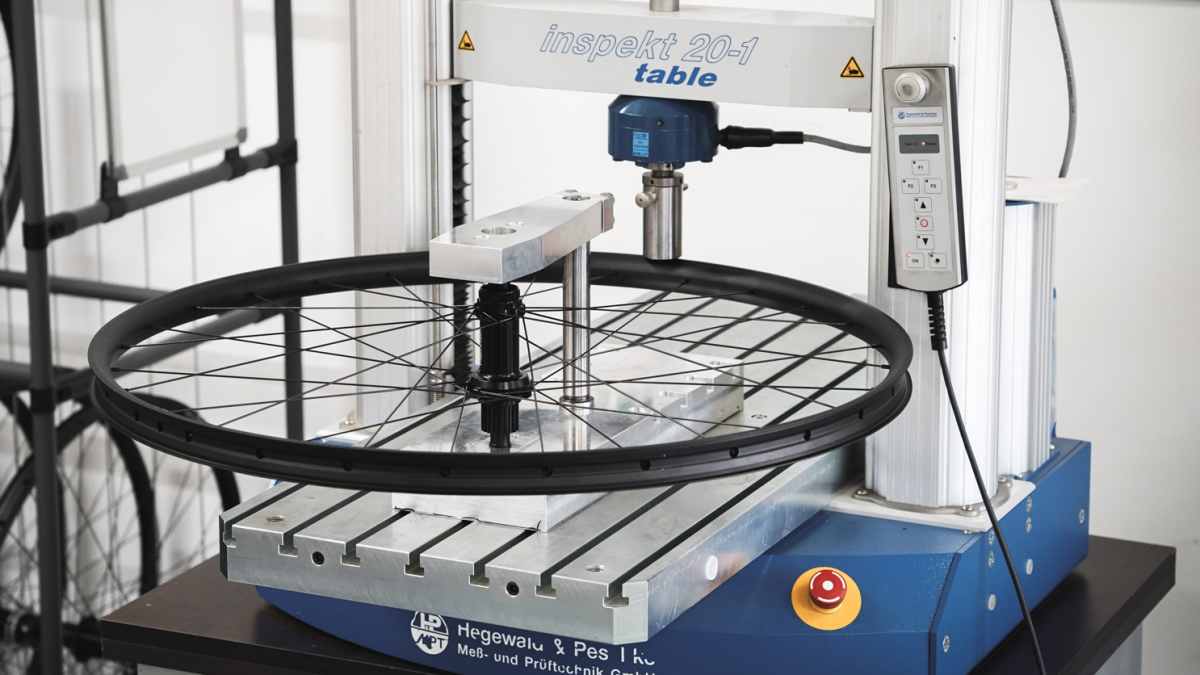
The inertia and geometry of a 32-inch bike make for less agile handling. The larger wheels require more effort during tight changes of direction and can feel cumbersome in technical sections. Wheel manufacturers, in particular, face the major challenge of bringing sufficiently stiff products to series production. According to a study by wheel manufacturer Newmen, 32-inch wheels deform by around 31 per cent more than 29-inch wheels under identical lateral loads. Due to the greater lever arm created by longer spokes, wheels are one of the biggest hurdles to the breakthrough of the 32-inch standard. Lateral stiffness must not fall below a certain minimum value. Some experts are therefore advocating the introduction of the Boost hub standard for gravel bikes in order to increase the flange spacing.
Concluding remarks
32-inch wheels roll better – and that’s what gravel bikes are meant to do most of the time: roll. It’s essentially their core strength, a characteristic that defines the appeal of gravel biking. Unlike mountain bikes, gravel bikes are rarely manoeuvred through tight, tricky sections and generally have to withstand less stress overall. With stiff rigid forks, they’re, in theory, easier to build to a light weight.
The advantages and disadvantages of large wheels vary in significance depending on the route profile. Long distances through the countryside are a major part of what makes gravel cycling so appealing. This is precisely where the superior rolling performance of 32-inch wheels really comes into its own. On routes with a high proportion of tarmac, short distances, winding courses or high average speeds, 32-inch gravel bikes can be at a disadvantage due to their greater weight, higher inertia, increased aerodynamic drag and compromises in manoeuvrability. The industry is not yet able to offer mass-market, affordable and lightweight designs.
What do you think: would you like to give a 32-inch gravel bike a go? Let us know in the comments!

Jan Timmermann
Editor