


All-road competition road bike: New Canyon Endurace CFR 2026 for Paris-Roubaix
Jens Klötzer
· 11.04.2026


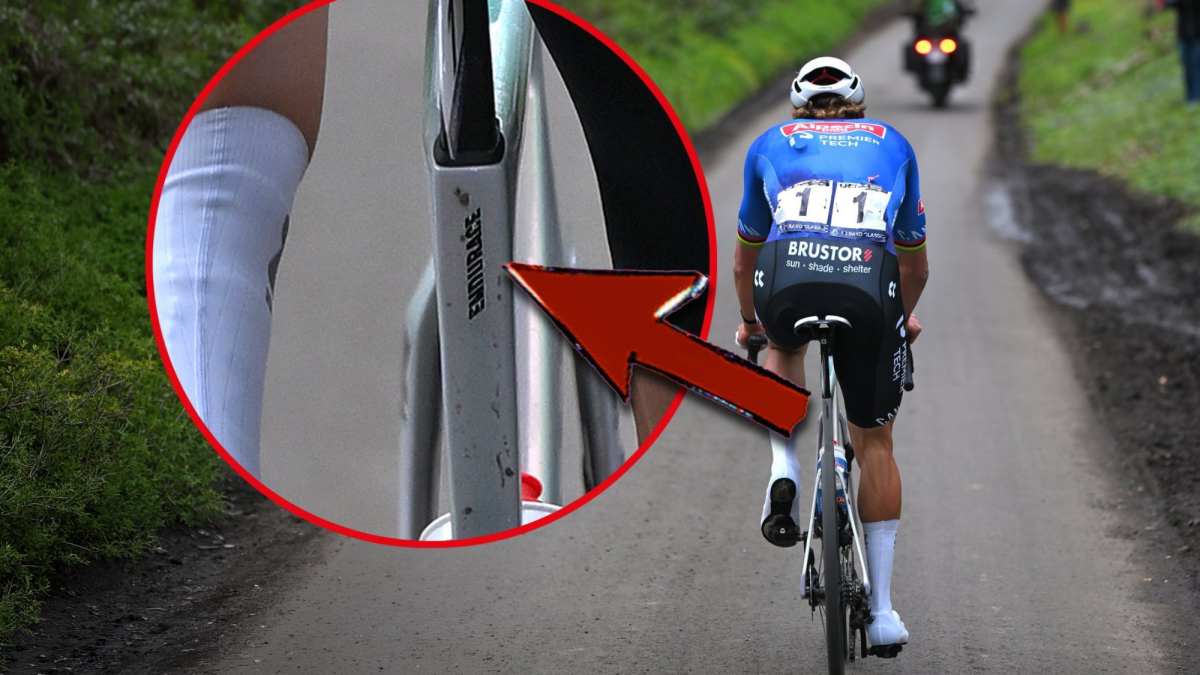
In recent weeks, Matthieu van der Poel and his team of racing drivers have already been using the new endurance model in the preparatory races in Belgium. The official manufacturer information now confirms what the first pictures already suggested: The new Endurace from Canyon is a departure from the claim of tailoring a model series solely to the needs of leisure riders. A very upright riding position and an extremely comfortable ride had previously characterised the model. Canyon has now developed the new Endurace CFR as a competition road bike for the toughest classic races, with aerodynamic frame shapes and an aggressive riding position.
Construction and frame
The new Endurace CFR frame uses a head tube profile that aerodynamically corresponds to the Aeroad CFR. The seat post, down tube, fork and rear triangle are also visually closer to the aerodynamic competition model than to its restrained predecessor. Canyon design engineer Chris Senn explains that the frame and geometry of the Endurace CFR are almost aerodynamically identical to the Aeroad. However, the wider tyres and increased comfort are intended to reduce fatigue.
One visible change is the taper in the lower part of the seat tube, which on the one hand provides more tyre clearance and on the other hand should contribute to the suspension capacity of the frame. The tyre clearance of the CFR is 35 millimetres on the frame and fork. The increased tyre clearance allows the use of modern, wide tyres for more volume, comfort and grip on rough surfaces.

In addition, the carbon layup is said to have been reinforced compared to the Aeroad. This should make the Endurace CFR stiffer than the Aeroad and also better able to withstand the stresses of cobblestone racing, which has been validated with a large number of tests.
Geometry
The Endurace CFR also adopts the sporty geometry of the Aeroad and Ultimate. The most expensive version is thus clearly positioned as a competition model. The CF SLX and CF models, the details of which will not be presented until May, will retain a more upright geometry, as known from the previous Endurace. According to initial information, the CF SLX will also have a new frame, while the CF is based on the frame shape of its predecessor.
The even greater tyre clearance of 38 millimetres on the CF SLX also requires a longer wheelbase and a longer front end - also to avoid contact between the tyre and the tip of the foot. The effective stack and reach values nevertheless remain almost identical for the same riding position, which is to be achieved with compact handlebars with a 10 millimetre shorter reach. The new Endurace CF SLX in size M has 418 millimetre chainstays and a wheelbase of 1009 millimetres, compared to 415 and 993 millimetres for its predecessor. This should make the new version somewhat more stable than before. According to initial information, the new Endurace CF SLX will also be compatible with mudguards and have an integrated storage compartment in the frame.
Wind tunnel test
But back to the Van der Poel bike: Canyon tested the Endurace CFR in the GST wind tunnel in Immenstaad, which TOUR also uses for its aerodynamics tests. According to Canyon, the Endurace CFR achieves an average system resistance of 205 watts at 45 km/h, just one watt above the Aeroad CFR, which is 204 watts. The test setup included two 600 ml bottles with mounts, DT Swiss ARC 1100 wheels with 65 mm rim height, a Continental Aero 111 tyre with 29 mm at the front and a Continental 5000 S TR with 30 mm at the rear.
Lots of comfort
With the SP0093 VCLS Aero, Canyon claims to have developed the first aero seatpost that combines speed with comfort. The shape and carbon layup have been optimised so that the seatpost offers 25 percent more vertical compliance than a rigid equivalent. However, the Scott Foil and the Merida Reacto already utilise comparable designs. The design ensures that the seatpost offers the same deflection regardless of extension, guaranteeing consistent comfort for all riders. The deflection of the Canyon post is 125 N/mm. This would make the suspension significantly firmer than before; the previous Endurace delivered measured values well below 100 N/mm in our tests.
New cockpits
The Endurace CFR uses the CP0048 PACE bar with classic lower handlebar as standard. The patented technology is already familiar from other models and enables simple position adjustments by allowing the handlebar width and height to be adjusted relatively quickly with a mini tool. There is no need to shorten the steerer tube, use excessive spacer towers or bleed the brakes. With 50 mm width variability and 20 mm height adjustment, one cockpit offers 15 different fit configurations. In 2026, PACE will be expanded into an ecosystem with three different lower link shapes to customise fit and riding feel.
The new CP0053 RACE Bar debuts with the Endurace CFR as a customisation option in the MyCanyon individualisation programme. It is a one-piece, non-adjustable design and the handlebar that the pros also ride in racing. It can also be retrofitted to all previous Aeroad, Ultimate and Endurace models. The V-shaped design gives the rider a significantly more stretched seating position: the position for the hands is 20 millimetres lower and ten millimetres longer.
The RACE Bar is also lighter and more aerodynamic: it weighs 350 grams, 120 grams less than the PACE Bar. In the wind tunnel, it saves 2 watts at 45 km/h compared to the PACE Bar on the same frame. The RACE Bar is available in stem lengths from 80 mm to 140 mm, with width options of 350 mm and 375 mm. The drop is 116 mm, the flare 14°.
Components and equipment
At market launch, the Endurace CFR is available in two equipment variants that differ only in the groupset: With Shimano Dura-Ace or SRAM Red AXS, it costs 8999 euros each. Both models roll on DT Swiss ARC 1100 wheels with a rim height of 65 millimetres and Pirelli P Zero RS tyres with a width of 35 millimetres. Both versions are available in six sizes from 2XS to XL and weigh 7.5 kg each at a price of 8,999 euros. Cheaper versions of the Endurace range are due to be launched in May.

Jens Klötzer
Editor