


Goodbye VPP rear triangle: Why Santa Cruz is opting for the four-bar linkage on the Tallboy
Max Fuchs
· 27.05.2026

The new four-bar linkage is neither an experiment nor a fashion statement. Santa Cruz based its decision on a specific target riding experience, used e-bike development as a blueprint and transferred the knowledge in a targeted manner. The test will show whether this is convincing in practice. The theory sounds convincing.
- Max Fuchs, BIKE test editor
Why change at all?
Santa Cruz has successfully used its characteristic VPP kinematics with a low-mounted damper on the Tallboy for years. The obvious question: why change that? Josh Kissner, Director of Product, makes the goal clear. The aim was to achieve a different ride feel on the Tallboy than on the previous models - not necessarily more suspension travel or more traction, but a qualitatively different characteristic: moderately progressive, supple on small bumps and at the same time agile and sporty.

This was more difficult to realise with the previous kinematics than with a four-bar linkage. So Santa Cruz made the change - consciously and with a clear objective.
What the four-bar linkage actually does
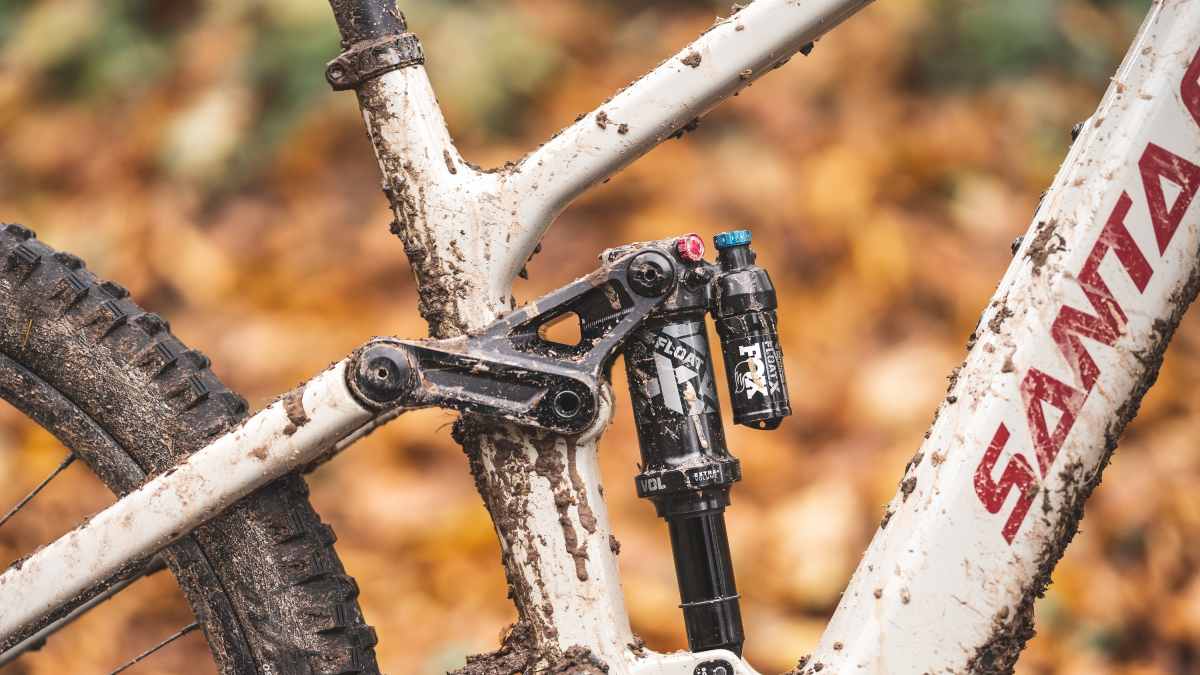
The technical advantages of a four-bar linkage in the trail bike sector are well documented. Three points are decisive for the new Tallboy:
Anti-Squat: Santa Cruz deliberately keeps the anti-squat value low. This keeps the rear end more active when pedalling - it therefore generates good traction and offers comfort even when the chain is pulled, but should also keep impacts away from the rider when going downhill. The disadvantage: The rear tends to bob more when pedalling, which could impair propulsion.

Anti-Rise: The even lower anti-rise value ensures that the suspension remains active when braking - the bike tends to stamp less and provides better grip during braking manoeuvres.
Pedal kickback: The four-bar linkage allows the pedal kickback to be specifically minimised. Less pedal kickback means that the chassis is more decoupled from the drive and can work more freely. The noise level also benefits from less pedal kickback.
What role the e-bikes played
The origin of the decision is interesting. Santa Cruz last used the four-link approach on its e-bikes - originally not only because of the riding experience, but also because there was simply no room for the motor in the bottom bracket area due to the well-known VPP design. The four-link offers more space.
The Tallboy naturally lacks the motor. But the knowledge from development remains - and can be transferred directly. The new four-bar linkage is not a product of chance, but a targeted technology transfer from e-bike development to the trail bike segment.
Practical side effects
The switch to the four-bar linkage brings two tangible additional advantages beyond the riding dynamics. Firstly, the frame weight is reduced - the new design is lighter than the VPP design, which brings the total weight of the Tallboy 2026 down to 13.2 kg. Secondly, the seatpost insertion depth has increased significantly. This allows for longer dropper posts in all sizes.
What this means
Santa Cruz has consistently followed through with a bold decision and justified it with a clear goal - a different riding experience. The e-bike development served as a test laboratory and the knowledge flowed directly into the trail bike. The result on paper: a bike that generates more traction uphill, brakes more controlled downhill and performs better in demanding terrain.
Whether this works in practice and whether the new Tallboy really feels as different as promised - the first test answers this question.
Conclusion from Max Fuchs, BIKE test editor
The new Tallboy stands and falls with its kinematics. Santa Cruz did not make the decision in favour of the four-bar linkage lightly, but with a concrete target riding experience and the backing of e-bike development. Whether the new kinematics are good for the Tallboy will be decided on the trail. But one thing is certain: the focus is clearly on off-road capability. And the way Santa Cruz has designed the four-bar linkage, the comparison with its predecessor could suffer.

Max Fuchs
Editor