


Scott Spark RC World Cup Evo review: The perfectly designed racing machine
Jan Timmermann
· 25.10.2026


Test result
| Property | Grade |
|---|---|
| Riding behavior | 1,8 |
| Lab | 1,3 |
| Equipment | 0,9 |
| Final grade | 1,5 |
You can find the full bike rating here
Data and facts about the Scott Spark RC World Cup Evo
| Suspension travel | 120 mm |
| Wheel size | 29"/622mm |
| Weight | 10.05 kg |
| Fork | Rock Shox SID Ultimate Flight Attendant |
| Rear shock | RockShox SIDLuxe Ultimate Flight Attendant |
| Drivetrain | SRAM XX SL Eagle AXS Transmission |
| Front brake | SRAM Motive Ultimate |
None other than the most successful cross-country rider of all time, Nino Schurter, helped develop the brand-new Scott Spark RC. Following the end of his World Cup career, it is now riding technique guru Bjorn Riley who, in the 2026 season, is whizzing the Scott Spark RC World Cup Evo around the racetrack with unrivalled ease. In true Scott style, the new Spark RC also features a shock absorber concealed within the frame and a whole host of clever design details. But does that actually make a cross-country race bike faster? Ultimately, it’s the results on the track that count. We put the new Scott Spark RC through its paces in an extensive test to find out just how good it really is.
Conclusion
With the new Spark RC, Scott has created an almost perfect World Cup race bike, missing out on victory in the high-end comparison test by the narrowest of margins. The suspension and geometry excel when riding hard. The downhill handling is a force to be reckoned with and is virtually unbeatable. Scott also proves that lightweight construction and value-adding features needn’t be mutually exclusive. Warning: brutally aggressive riding position! - Jan Timmermann, BIKE editor
The Scott Spark RC World Cup Evo in detail
- Intended use: Cross-country / Marathon
- Price: 11,499 euros
- Frame material: carbon
- Available sizes: S / M / L / XL
- Maximum system weight: 130 kg
- Warranty: 5 years
- Special features: Flex-Pivot, integrated damper, frame storage compartment, integrated seatpost clamp, SAG indicator, tool mount, handlebar stop limiter, handlebar angle adjustment via headset
Lightweight despite system integration
Although the price on the tag might seem daunting at first glance, it puts itself into perspective when compared with other high-end cross-country full-suspension bikes, which can easily cost a further 3,000 euros. In fact, the World Cup Evo model isn’t officially the top-of-the-range model in the Spark RC family. For those who are particular about every gram and willing to invest an extra 1,500 euros for a carbon chainstay and even further optimised carbon material, Scott has positioned a bike with identical spec but a frame that’s around 140 grams lighter at the top of the range.
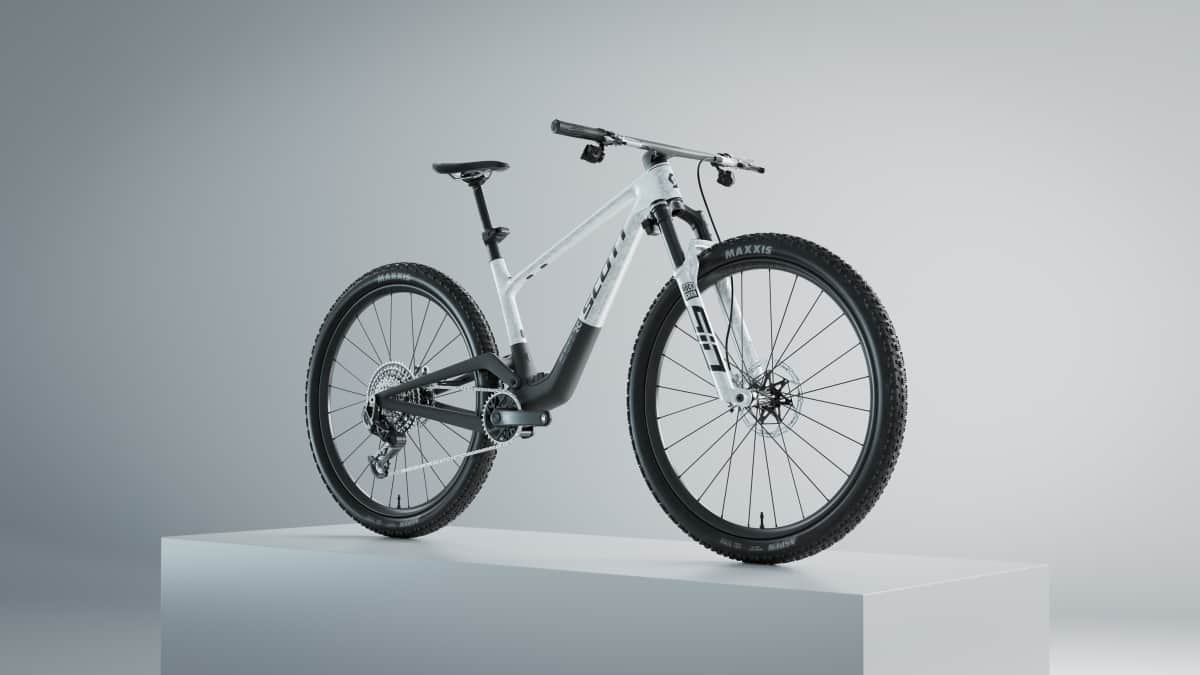
Either way, the HMX carbon frame on our test bike weighs just 1,773 grams in size XL. This puts the Scott on a par with other cutting-edge World Cup race bikes, and in terms of engineering, it is only beaten by lightweight specialists such as the Specialized Epic 9 or the Arc8 Evolve FS. The frame weight is particularly impressive given the numerous features Scott has included on the bike. The chassis has two large, covered openings in the down tube, providing access to the rear shock, mini-tool and frame storage compartment with tool pouch. Much like in convertibles, large holes usually make a frame heavier, not lighter, as the lack of structure must be compensated for elsewhere with more material to ensure stability. In fact, the Spark frame achieves only relatively low stiffness values. According to the developers, however, this is by design: the deliberate frame flex is intended to give the race bike greater comfort and traction. In testing, even test riders weighing 90 kilos did not complain about a lack of stiffness.
To top off the exceptional frame design, there are integration features such as a recessed seatpost clamp, a tool mount beneath the top tube, a handlebar stop limiter and a SAG indicator on the left-hand side of the crankset. It’s therefore quite remarkable that the Scott Spark RC World Cup, in its largest frame size and without accessories, only just tips the ten-kilo mark. For their money, customers get a lifetime guarantee on the fitted CeramicSpeed bearings, silver hubs with a lovely sound and a fork in the same paint finish as the frame – that’s just how we like it! Every paint finish is hand-dabbed. No two bikes are alike. With a five-figure price tag, high-end spec goes without saying.
Sporty but not too tough
With the new Spark RC, Scott has opted for an extremely sporty, stretched riding position. A long top tube is paired with a relatively long stem and a short head tube. The stack height is significantly lower than on current race bikes from Canyon or Specialised, for example, and stretches the rider’s body far across the bike. For die-hard racers, this will feel familiar. They feel well integrated into the frame on the Spark RC. For everyone else, there’s a risk of that ‘stretching-bench feeling’. This is mainly because the seat angle is relatively flat. The rear-biased pedalling position was by no means to every tester’s liking. Regardless, the new Syncros wheels with carbon spokes accelerate superbly and get the Scott up to speed quickly.
The Scott climbs skilfully towards the summit. Traction is excellent and it remains comfortable even with the suspension locked out. The Swiss have clearly got the balance right between frame flex, suspension and wheelset. Marathon routes featuring long gravel climbs and trail ascents are right up the comfortable Spark RC World Cup Evo’s street. However, to improve pedalling efficiency, we moved the saddle to the very front position. At 75 degrees, the seat angle is on the flatter side compared to modern rivals. With the suspension open, the rear end tends to rock slightly when standing on the pedals. Platform damping is a must in a race! Fortunately, the RockShox Flight Attendant System locks up reliably and fully automatically.
There’s only one gear: full throttle
Whilst the Scott Spark RC does a good job of isolating the rider from vibrations and small bumps, the mid-travel range is noticeably stiffer. On flat trails with plenty of roots and stones, the rider’s arms get plenty of feedback from the ground. Although it’s easy to pick up speed on the trail, fatigue sets in a little sooner on rough terrain than with some other latest-generation race bikes. Finding the right setup for the RockShox Flight Attendant automatic suspension for these situations proved tricky during testing. We found ourselves having to fiddle with the bias setting remarkably often.
We preferred to push a bit harder on the pedals to build up more momentum. The Spark RC’s suspension performs significantly better at high speeds. Anyone who ploughs through the terrain with proper oomph will be rewarded by the Scott. During the test, we had quite a few ‘wow’ moments on steep, step-filled descents. The rear suspension literally soaks up rough impacts and boasts brilliant end-stroke progression. Here, the Swiss manufacturers pay tribute to modern cross-country courses and equip the race bike for the rough and tough. Drops onto flat ground and nasty root edges are the Spark RC’s breakfast. A 120-millimetre suspension system – and its direct predecessor – has rarely been able to do this, and certainly not for a long time. If the race goes on for a while and the rider is tired but doesn’t want to let the pace drop, the design still forgives the odd riding mistake. On the descents, the new Spark is a real rocket: focused, stable and bloody fast.
The downhill potential of the new Scott Spark RC is enhanced by a generous wheelbase and a 66.4-degree head angle. The latter can be lowered by a full degree in two stages using adjustable headset cups. However, we already rode very well with the steep setting, and most of the Scott World Cup pros also rely on this setup. Despite its long main frame and low front end, this lightweight race bike still lifts effortlessly onto its rear wheel, thanks to the chainstays, which are just 431 millimetres long. The integrated shock absorber keeps the centre of gravity low in the bike. Combined with wheels that turn readily and a confident commitment to the ideal line, the Scott handles tight corners with ease. The Maxxis Aspen tyres are voluminous, provide good shock absorption and roll quickly on dry days, but offer little tread grip.
The new Scott Spark RC excels at jumps and small gaps. It’s hard to imagine what a model of handling the Swiss manufacturers could have created with a shorter seat tube and a longer dropper post. This potential was presumably sacrificed in favour of a second bottle cage mount and top-mounted shock access. Nevertheless, the Spark RC World Cup Evo offers a high level of riding enjoyment for a competition bike. No wonder, then, that Bjorn Riley is thrilling fans worldwide with his radical riding manoeuvres aboard the Scott.
Test results from the BIKE test laboratory
- Total weight: 10.05 kg (BIKE measurement, size XL, excluding pedals)
- Frame weight excluding shock absorber: 1773 g
- Weight of shock absorber: 371 g
- Fork weight: 1631 g
- Weight of wheels: 3531 g (front and rear combined, including tyres, brake discs and cassette)
- Inertia of the wheels: 2886 kg/cm² (the lower the value, the faster the acceleration)
- Frame stiffness (front/rear): 5 / 14.5 N/mm
- Customer service rating: 11.5 out of a maximum of 15 points (good)
Facilities
- Fork / Shock: RockShox SID / SIDluxe Ultimate Flight Attendant
- Drivetrain / Gear ratio: SRAM XX SL Eagle AXS transmission (1 x 12), 34; 10–52 (520 per cent)
- Brakes: SRAM Motive Ultimate, 180 / 160 mm
- Dropper post: SRAM Reverb AXS, 150 mm
- Wheels: Syncros Silverton CF1
- Tyres: Maxxis Aspen MaxxSpeed Exo TR, 29 x 2.4”
Strengths and weaknesses
Pro
- lightweight despite system integration and numerous frame features
- enormous suspension reserves when driving hard
- confident yet playful handling in every situation
- a very fast downhill skier
Cons
- Stiff rebound damping in the mid-travel range can cause fatigue at low speeds
- The seat tube is likely to be shorter and steeper
- A sporty, rear-biased riding position isn’t to everyone’s taste
The BIKE rating
| Category: XC full-suspension bikes | Weighting | Grade |
| Uphill handling | 15 per cent | 2.0 |
| Uphill Efficiency Suspension | 15 per cent | 2.0 |
| Playfulness | 8 per cent | 2.0 |
| Downhill handling | 12 per cent | 1.5 |
| Downhill suspension | 15 per cent | 1.5 |
| Rating: Handling | 65 per cent | 1.8 |
| Weight | 6 per cent | 0.8 |
| Inertia wheels | 4 per cent | 2.0 |
| Laboratory Grade | 10 per cent | 1.3 |
| Quality of fittings | 5 per cent | 0.8 |
| Usability / Added value | 5 per cent | 1.3 |
| Carrying capacity of bottle holders | 5 per cent | 1.0 |
| Saddle depth adjustment | 5 per cent | 1.0 |
| Quality / Workmanship | 5 per cent | 0.5 |
| Grade: Facilities | 25 per cent | 0.9 |
| BIKE rating | 100 per cent | 1.5 |
The BIKE rating system is independent of price and is based on the school grading system.
What do you think: is the new Scott Spark RC a worthy successor to Nino Schurter’s bike? Let us know your thoughts in the comments!

Jan Timmermann
Editor