


Canyon Lux World Cup CFR X0 AXS review: All the bells and whistles for half the price
Jan Timmermann
· 23.10.2026


Test result
| Property | Grade |
|---|---|
| Riding behavior | 2,0 |
| Lab | 2,0 |
| Equipment | 1,4 |
| Final grade | 1,9 |
You can find the full bike rating here
Data and facts about the Canyon Lux World Cup CFR X0 AXS
| Suspension travel | 120 mm |
| Wheel size | 29"/622mm |
| Weight | 11.28 kg |
| Fork | Rock Shox SID Select+ |
| Rear shock | Rock Shox SIDLuxe Select+ |
| Drivetrain | SRAM X0 Eagle AXS Transmission |
| Front brake | SRAM Motive Silver |
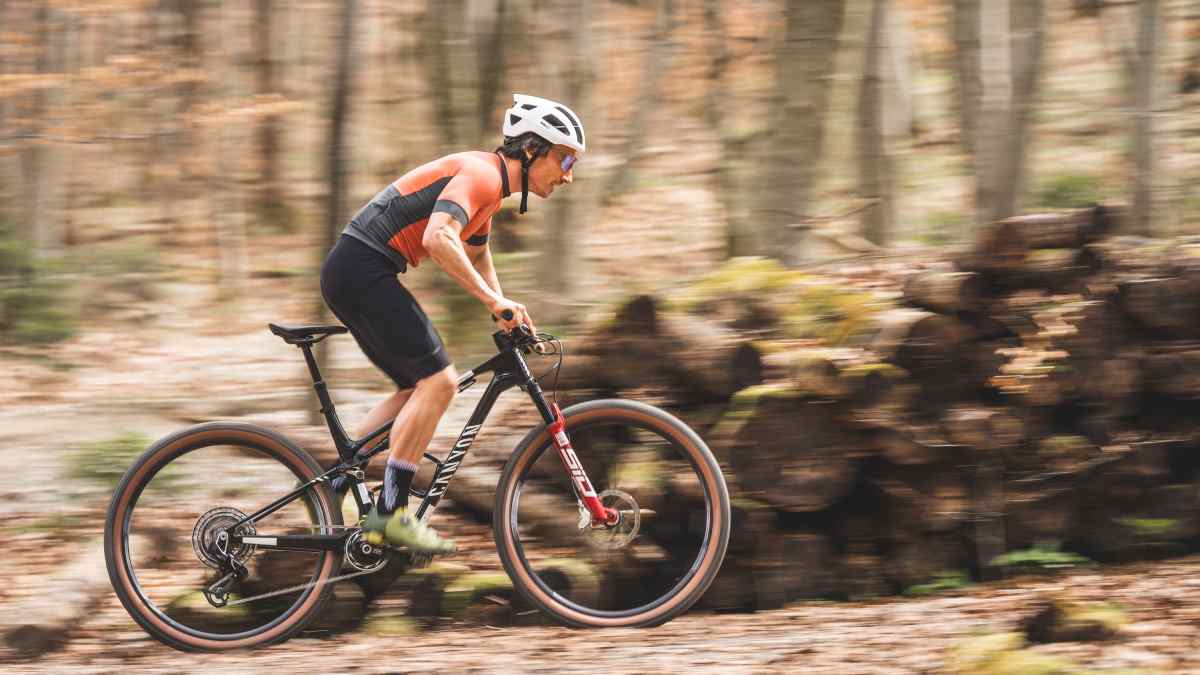
Although the Canyon Lux World Cup CFR X0 AXS is fitted with high-quality components throughout, such as a carbon wheelset and a wireless drivetrain with a power metre, it is only considered upper mid-range within the Canyon range. Above our test bike, priced at 5,999 euros, there are two even higher-end models. However, that doesn’t mean the Lux World Cup CFR X0 AXS is a second- or third-tier race bike – quite the opposite! We compared this sensible racer with some of the most expensive cross-country bikes in the world and were surprised.
Conclusion
It’s incredible how well the significantly cheaper Canyon holds its own against the high-end competition. The geometry and suspension are exceptionally well-balanced. The handling and ride quality of this top value-for-money bike are impressive. The Lux World Cup CFR X0 AXS is a proper racer. Only if riders want to squeeze out that last bit of speed and suspension performance will they need to invest more. - Jan Timmermann, BIKE editor
Canyon Lux World Cup CFR X0 AXS in detail
- Intended use: Cross-country / Marathon
- Price: 5,999 euros
- Frame material: carbon
- Available sizes: S / M / L / XL
- Maximum system weight: 120 kg
- Warranty: 6 years
- Special features: Flex-Pivot, Anti-Squat Flip-Chip, Tool-Mount, tool-free rear wheel removal, steering stop limiter
The question of price
Racers will find everything they need on the Canyon Lux World Cup CFR X0 AXS. From the pedal sensor to two bottle cages, a mini chain guide and a handlebar stop limiter, right through to a tool mount beneath the top tube, the Koblenz-based team have thought of everything you might need for training and race day. An anti-squat flip chip allows the kinematics to be adjusted to the chainring size. The spec list is impressive: Rockshox suspension components featuring high-quality Select+ damping technology, tried-and-tested carbon wheels from DT-Swiss and a Schwalbe tyre combination typical for the discipline. For a comparable deal, specialist retailers charge between 1,000 and 1,500 euros more.

With high-end cross-country race bikes, there is generally a sharply declining price-performance curve. The higher the price tag, the smaller the gains in performance. In high-end racing, it’s all about squeezing out the tiniest of advantages. This usually comes at a high cost. The Canyon Lux World Cup CFR X0 AXS strikes an excellent balance between price and performance. That’s all XC racers at non-national level need.
Not a laboratory rat
But did Canyon cut corners on development costs for the Lux World Cup CFR in order to keep the price down? The BIKE test lab reveals that this isn’t necessarily the case. The bare carbon frame of the Canyon weighs just 51 grams more than that of the highly acclaimed Specialized S-Works Epic 9 – which, incidentally, is 1,000 euros more expensive than the complete Canyon bike, including suspension components. When it comes to overall weight and wheel inertia, however, the budget mail-order bike has to concede the lead to the frontrunner in its category. The S-Works, priced at 14,499 euros, ultimately weighs 9.9 kilos as a complete bike in size XL. By way of comparison: Canyon quotes the same figure for its top-of-the-range Lux World Cup CFR XTR Di2 model, priced at 7,999 euros, in frame size M. Our test bike is a full 1.4 kilos heavier. Around 80 per cent of this weight disadvantage is attributable solely to the steel-spoked wheels.
The Lux World Cup CFR achieved a good, but not excellent, rating in the lab. There is potential for weight optimisation (for a significant extra cost) in the wheels, seatpost and drivetrain. The price difference is also huge compared with the top-of-the-range models from Giant, Scott, Santa Cruz and others. Seen in that light, the disadvantage in the lab test results seems minor.
Complete control
In a blind test, it would probably be almost impossible to tell that the Canyon rear end has ‘only’ 110 millimetres of travel, whilst most of its rivals hit the track with an extra centimetre of suspension travel. It’s worth noting, however, that some high-end designs manage to extract even more comfort from their limited travel. The Lux suspension is a very reliable workhorse with a sporty character, but it doesn’t quite offer that final touch of refinement. Its strength lies in its controlled performance. The Canyon performs superbly, particularly in the mid-travel range, maintaining stability throughout the stroke and lending the ride a sense of composure. This holds true even when things get really intense. Lux riders can always rely on precise damping. Plough straight into a rocky section and then pull away on the jump? No problem!
When it comes to sensitivity to small bumps, the rear suspension doesn’t quite measure up to the best in the field. Racers shouldn’t expect a ‘flying carpet’. The utilisation of travel has improved compared to its predecessor, yet the rear end still exhibits pronounced end-stroke progression. The final ten millimetres are rarely used. Whilst the Canyon handles hard impacts competently, it always makes it clear to the rider: “You’re riding an efficient race bike, not a comfortable trail bike!”
Complete control
The handling of the Canyon Lux World Cup CFR is, in keeping with the suspension, very well-controlled. Any nasty surprises? Not a chance! This really shows just how well the team from Koblenz have tuned the bike. It’s by no means a temperamental diva, but scores highly with its good-natured controllability in all situations. Rider integration is exemplary, whilst the geometry and spec aren’t too extreme. As a result, the Canyon is forgiving of the odd mistake. With large HS2 discs, the braking power of the SRAM Motive brakes is well suited to the bike’s intended use. On the XL frame size, we’d favour a slightly longer dropper post for steep descents.
The 66.1-degree head angle provides the confidence needed to build up decent speed on challenging lines. During testing, all riders praised the bike’s smooth ride and stability at race pace. One slight drawback: in particularly technical sections at very low speeds, this is the only situation where control on the Lux isn’t ideal. In such cases, the Canyon needs an experienced hand on the handlebars, and shorter bikes with a slightly steeper head angle are easier to handle. Playing around isn’t one of its core strengths. In a race, however, that should be the exception rather than the rule.
Strikingly unobtrusive
Canyon has got the seating position on the Lux World Cup CFR spot on. Even on uphill sections, the rider is well integrated into the progressive yet not excessively long bike. The Lux has moved away from the aggressive, race-oriented position of its predecessor and now offers its rider a modern and balanced ride. Overall, the riding position is strikingly unobtrusive and works well even over many kilometres. The one-piece carbon cockpit is narrow from the factory at 740 millimetres, but offers very comfortable ergonomics. A particular highlight: your hands can grip the centre of the handlebars perfectly, allowing you to adopt an aerodynamic posture on flat sections.
When pedalling out of the saddle, the Canyon’s rear triangle sways only slightly under load. Thanks to the three-stage shock platform with handlebar remote, this can be disabled with a single flick of the wrist. The Canyon Lux World Cup CFR does without the outrageously expensive electronic Flight Attendant system with automatic lockout. However, the mechanical solution has its own appeal and works flawlessly. Canyon has optimised the middle platform in particular on the Lux CFR. It’s ideal for rough gravel and gentle trail climbs. Traction is solid, though not the best in its class. The race bike can also be pushed up technical sections with ease.
In its price range, the Lux World Cup CFR X0 AXS impresses with its weight, and its acceleration leaves little room for criticism. It’s only when compared head-to-head with significantly more expensive bikes that you realise the affordable Canyon has a slightly heavier carbon frame and that the wheels’ acceleration figures are merely average. This brings us back to the conclusions drawn from the lab data: unfortunately, mid-range spec simply isn’t enough for top-class acceleration. Racer who are truly unwilling to compromise would be better off treating themselves to Canyon’s top-of-the-range model, which costs 2,000 euros more.
Measurements from the BIKE test laboratory
- Total weight: 11.28 kg (size XL, excluding pedals)
- Frame weight excluding shock absorber: 1641 g
- Weight of damper: 400 g
- Fork weight: 1668 g
- Weight of wheels: 4057 g (including tyres, brake discs and cassette)
- Inertia of the wheels: 3085 kg/cm² (the lower the value, the faster the acceleration)
- Frame stiffness (front/rear): 5.8 / 18.4 N/mm
- Customer service rating: 5 out of a maximum of 15 points (poor)
Facilities
- Fork / Shock: RockShox SID / SIDluxe Select+
- Drivetrain / Gear ratio: SRAM X0 Eagle AXS transmission (1 x 12), 34; 10–52 (520 per cent)
- Brakes: SRAM Motive Slvr, 180 / 160 mm
- Dropper post: Canyon Dropper, 150 mm
- Wheels: DT Swiss XRC 1500
- Tyres: Schwalbe Racing Ray / Racing Ralph Addix Speed Super Race TR Evo, 29 x 2.35”
Strengths and weaknesses
Pro
- lightweight frame despite its very attractive value for money
- A well-balanced, modern riding position offering a high degree of control both uphill and downhill
- A well-balanced racing concept with a specially tuned chassis
Cons
- cannot compete with the best (but much more expensive) race bikes in the lab
- Rear end with slightly less reserve and sensitivity
- poor customer service
BIKE rating
| Category: XC full-suspension bike | Weighting | Grade |
| Uphill handling | 15 per cent | 1.8 |
| Uphill Efficiency Suspension | 15 per cent | 1.5 |
| Playfulness | 8 per cent | 2.3 |
| Downhill handling | 12 per cent | 2.0 |
| Downhill suspension | 15 per cent | 2.8 |
| Rating: Handling | 65 per cent | 2.1 |
| Weight | 6 per cent | 2.0 |
| Inertia wheels | 4 per cent | 2.0 |
| Laboratory Grade | 10 per cent | 2.0 |
| Quality of fittings | 5 per cent | 1.4 |
| Usability / Added value | 5 per cent | 2.0 |
| Carrying capacity of bottle holders | 5 per cent | 1.0 |
| Saddle depth adjustment | 5 per cent | 1.0 |
| Quality / Workmanship | 5 per cent | 1.5 |
| Grade: Facilities | 25 per cent | 1.4 |
| BIKE rating | 100 per cent | 1.9 |
The BIKE rating system is independent of price and is based on the school grading system.
What do you think: is it better to spend a lot of money to squeeze out that last bit of performance, or to go for an affordable cross-country bike? Let us know your thoughts in the comments!

Jan Timmermann
Editor