A visit to the MTB Museum: Reporter Holger Meyer on the road in the Netherlands
Holger Meyer
· 15.08.2026


The old school doors swing open on both sides, just like in a Western saloon, as I step into the Mountain Bike Museum in Arnhem. Standing behind them is Jeroen van Roekel – a calm, friendly man who speaks German with a charming Dutch accent. He’s leaning casually against a homemade wooden bar. In front of it are fluffy bar stools upholstered in fur, which look as though they’ve already heard countless cycling stories. “Are you a cycling fanatic too?” he asks me, even before I’ve properly settled in. I nod. I’ve got a few old treasures at home – a Yeti, a Panasonic, some old GTs and, of course, 25 years of Scott history. “I’m old,” I say. Jeroen laughs.
Behind the museum lies a hilly wooded area. A legal and well-maintained network of trails – a project that Jeroen launched ten years ago. A former school, converted into a museum, with a trail park behind it: a mountain-biking fairy tale that hardly anyone knows about. Why is that, actually? Jeroen shrugs. Support from the industry? Hardly. Help from the government? None. And he can no longer work himself – his eyesight is just one per cent in one eye and six per cent in the other. “So I run the museum. Full-time,” he says. Free entry. Everything runs on donations. All driven by passion.
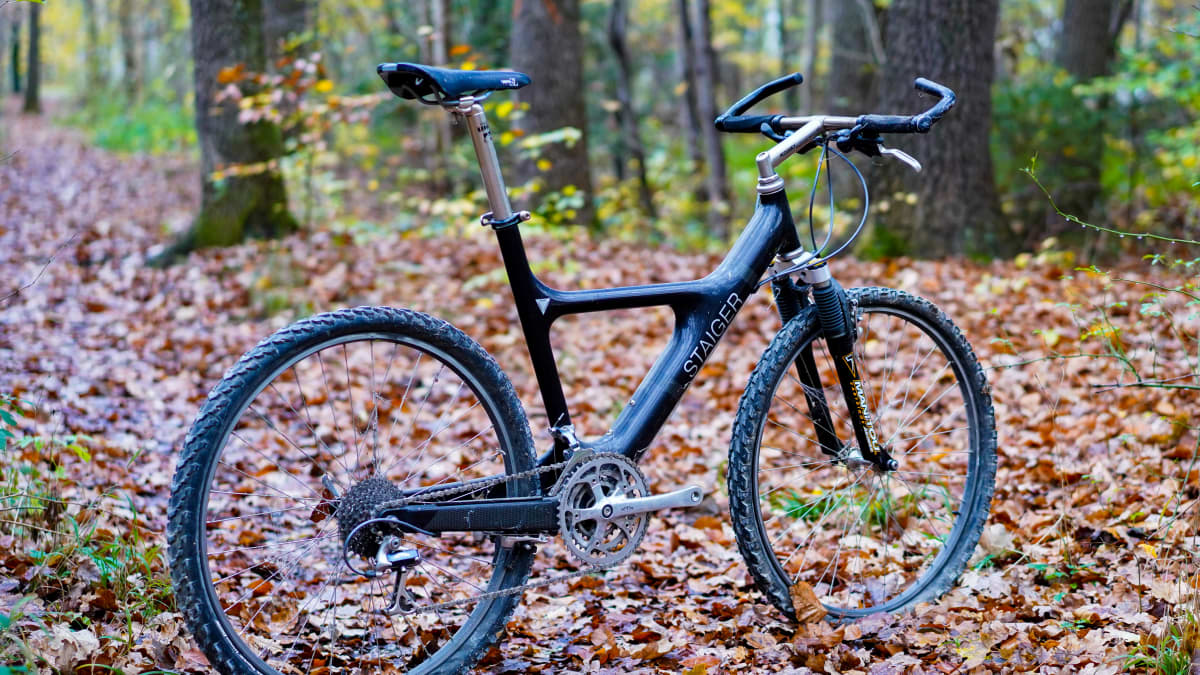
In the museum, as I walk round, I feel as though I’m travelling back in time. Classroom by classroom, the museum recounts four decades of mountain biking history. The bikes are neatly arranged by year of manufacture. Countless frames hang from the ceiling, patiently awaiting their rebirth. Some are decades old, whilst others were once considered icons of the scene. Jeroen talks about his mechanics – the volunteers who come in during the week to breathe new life into old bikes. At the weekend, he opens the museum. In the old sports hall, around a thousand suspension forks lean against the walls. Visitors can eat their sandwiches here and lose themselves in nostalgia.

The highlights … For me, it’s the speed record bike ridden by Giovanna Bonazzi – the downhill queen of the 90s. And the polished Subaru bike with switchable four-wheel drive. Of course, I also love the old, light-blue VW bus that Jeroen and his team use to travel to retro bike events. Always with old bikes in the boot and always accompanied by music from vinyl records. Preferably AC/DC. “Just like in the old days,” he says. But the project is fragile. It thrives on passion – and on the few people who understand how important it is not only to preserve the history of mountain biking, but to bring it to life.
Jeroen’s vision for the future is clear: through the museum, he wants to create a place where cyclists of all ages can come together and discover the roots of their sport. Whether this succeeds depends on how many people are inspired by this idea. What Jeroen has created here is more than just a museum. It’s a piece of cultural history. A living archive. A place where you can sense why mountain biking is more than just a sport. It’s passion. It’s enthusiasm. And perhaps we really do need more people like Jeroen – people who are passionate about the scene when no one else is.

If you’d like to support him, there are plenty of ways to do so: by paying a visit, making a donation, buying a piece of merchandise, or even donating an old bike that you’ve never been able to part with because it holds too many memories. It’ll find a new home here.
But not every bike is accepted. Jeroen’s collection has grown considerably in the meantime. He’s mainly looking for genuine rarities or models that are in better condition than the exhibits already on display in Arnhem. And Jeroen? He’s back behind his bar, pouring coffee and saying: “It’s not about the money for me. It’s about the history.”