


Radon Regard 7.0 vs Canyon Grizl CF 7: A comparison of affordable carbon gravel bikes
Josh Welz
· 24.07.2026

Conclusion on the Radon versus Canyon showdown
The new Canyon Grizl has a more distinct profile: with its comfortable geometry, classic two-piece aluminium cockpit, frame storage compartment and numerous mounting points for luggage and other gear, it is clearly aimed at the adventure and bikepacking crowd.
The Radon has real sex appeal – with a stylish carbon frame and a sleek one-piece cockpit. Despite its moderate geometry and various mounting points for panniers, bottle cages and everyday kit, its preferred terrain is fast gravel and tarmac tracks. However, we don’t think the 1x12 drivetrain with a 1-51 cassette is the right choice. All in all, though, the Radon impresses with its broader range of use.
Carbon frames, single-chainring drivetrains, hydraulic disc brakes and 45-millimetre-wide tyres – the key specifications of the Radon Regard 7.0 and the Canyon Grizl CF 7 are identical. Both gravel bikes are aimed at riders looking for a modern carbon bike at a comparatively affordable price.
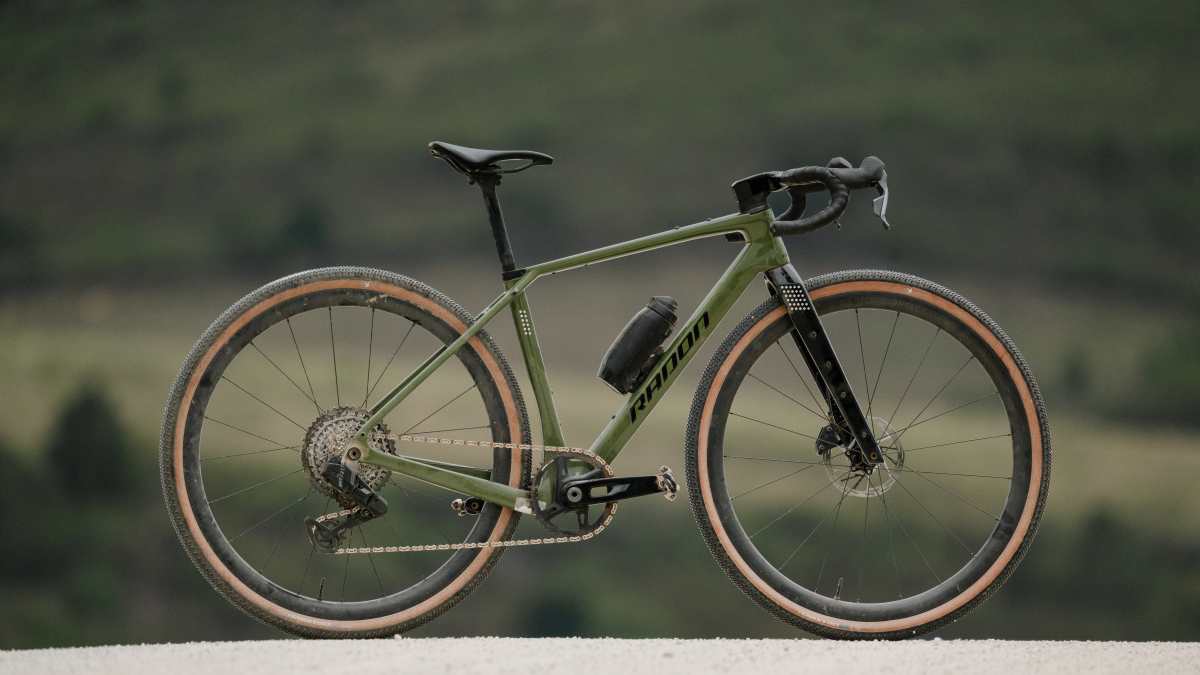
In fact, however, the two manufacturers are aiming to appeal to different target groups with their affordable carbon gravel bikes. The Radon Regard 7.0, a nine-kilo gravel bike with an integrated carbon cockpit, is designed to appeal to the sporty crowd. It is designed to perform equally well on tarmac, fine gravel and fast country lanes, as well as on more challenging day trips. Although the frame features mounting points for luggage, mudguards and bikepacking accessories, its fundamental character is geared more towards fast riding.

The Canyon Grizl CF 7 is – as Canyon puts it – the versatile adventure and bikepacking bike. Its frame accommodates tyres up to 54 millimetres wide, features numerous mounting points, an integrated storage compartment in the down tube, and mounts on the fork for luggage racks, mudguards and accessories. Canyon positions the Grizl as a particularly versatile gravel bike for long tours, rough terrain and rides with luggage. Weighing 9.8 kilos in size M, it is about three-quarters of a kilo heavier than the Radon.
So, in theory, it all makes sense. But what about in practice? The fact is: the target groups and areas of use often overlap: even adventure cyclists go for their after-work training rides. Likewise, some race gravel cyclists seek out micro-adventures on overnight trips at the weekend. So it’s fair to ask: which is the better all-round bike?
Target group: larger overlaps
Both gravel bikes feature a carbon frame with fully integrated cable routing and a carbon fork. The frame features mounting points for bottle cages, panniers, mudguards and a luggage rack. The maximum permissible weight is 115 kilos for the Regard and 120 kilos for the Grizl. All of this shows that the Regard, too, is designed to be quite versatile.
However, Canyon takes its adventure mission a bit more seriously. It features a more sophisticated frame – with a storage compartment integrated into the down tube, mounts for a FidLock frame bag, a third bottle cage beneath the down tube, a top tube bag, a rear rack and mudguards. And the carbon fork offers three mounting points on each side. The official tyre clearance is a generous 54 millimetres. This means the Grizl is more specifically designed for adventure and bikepacking.
Features: Has someone got it wrong?
The Regard 7.0 appeals to cyclists looking for a fast and comparatively lightweight gravel bike, says Radon. Judging by the weight and the super-stylish integrated cockpit, that seems to be the case. But we find ourselves wondering: why, then, have the product managers fitted a Shimano GRX 1x12 with a 10-51 cassette? Sure, single-chainring drivetrains are all the rage at the moment. And so, apparently, are 10-51 mountain bike cassettes. Unfortunately, because anyone who mainly rides on flat terrain and fast surfaces would be better off with a more closely spaced 10–45 cassette than with a 10–51 cassette with its huge gear gaps. The 10–45 cassette, however, is fitted to the Grizl CF 7. Here, on the other hand, one wonders: wouldn’t bike packers and adventurers carrying heavy luggage in particular be glad to have a large mountain sprocket?
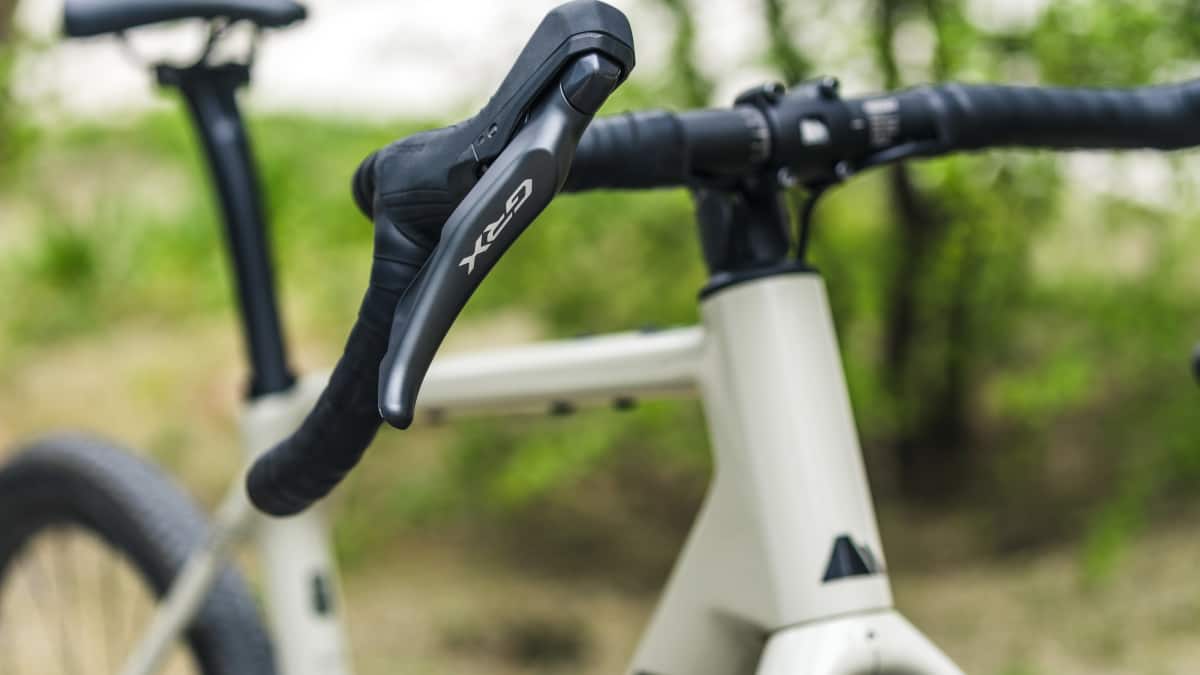
When it comes to brakes, both manufacturers have turned to Shimano. They’ve opted for the GRX hydraulic brakes with 160-millimetre discs – a tried-and-tested braking system in the budget gravel segment.
Cockpit: This is where our paths part for good
When it comes to the cockpit, both manufacturers are seeking to sharpen the character of their respective bikes. For the Regard 7.0, Radon has opted for an ultra-stylish, sporty, flat, one-piece carbon cockpit. The cables are routed entirely internally. This creates a clean, uncluttered look and saves a little weight compared to a classic two-piece aluminium combination. The handlebars feature significantly flared ends and a flat drop – providing comfort and control off-road.
One drawback of the integrated cockpit is its limited customisability. The stem and handlebars cannot be adjusted independently of one another. Anyone requiring a different stem length or handlebar width will have to replace the entire unit. For riders of average build, however, the standard configuration should work well.
On the Grizl CF 7, Canyon combines a slightly steeper aluminium stem with aluminium handlebars – a combination that can be better tailored to individual preferences. As standard, size M comes fitted with a short 60-millimetre stem and a rather wide 440-millimetre set of handlebars. Here, too, the handlebar ends are significantly flared and the drop is rather shallow. This is a set-up that is clearly designed with comfort in mind.
Geometry: The Grizl is longer, taller and runs more smoothly
| Geometry date, size M | Radon Regard CF | Canyon Grizl CF 7 | Difference |
| Stack | 583 mm | 596 mm | Canyon +13 mm |
| Reach | 393 mm | 404 mm | Canyon +11 mm |
| Top tube length, horizontal | 560 mm | 581 mm | Canyon +21 mm |
| Head tube length | 150 mm | 158 mm | Canyon +8 mm |
| Steering angle | 71.5° | 71.0° | Canyon 0.5° flatter |
| Seat angle | 74.5° | 73.5° | Canyon 0.5° shallower |
| Chainstay length | 435 mm | 440 mm | Canyon +5 mm |
| Wheelbase | 1041 mm | 1076 mm | Canyon +35 mm |
| Bottom bracket lowering | 75 mm | 75 mm | equal |
| Overhang height | 808 mm | 826 mm | Canyon +18 mm |
The Canyon is tall and long, whilst the Radon is moderately compact. Thanks to a shorter wheelbase, shorter chainstays and a steering angle that’s half a degree steeper, the Radon feels lively and agile to ride. However, the Grizl responds more directly to steering inputs thanks to its more compact cockpit. It is striking that both models feature a significant bottom bracket drop of 75 millimetres. This lowers the centre of gravity and improves cornering stability. On technical terrain, however, this increases the risk of the pedals catching on the ground.
Riding characteristics: speed with the Radon, safety with the Canyon
Thanks to its lighter weight and more compact geometry, the Radon Regard 7.0 offers a sportier ride. It accelerates more nimbly and feels more agile. The 10–51 cassette helps on steep climbs, though a finer gear ratio would be desirable on fast, flat sections. The integrated, elongated carbon cockpit also adds to the sporty feel. At the same time, the wide handlebars and flared drops ensure sufficient control when the terrain gets rougher. The Regard is therefore definitely not a race gravel bike, but a sporty and stylish all-rounder.
The Canyon Grizl CF 7 rides much more smoothly and confidently. The combination of a long wheelbase, a flat steering angle, a high front end and wide handlebars instils confidence on fast descents and challenging trails. Potholes and loose sections are less likely to unsettle the bike. The downside of this design becomes apparent on twisty, narrow trails, where the Grizl feels a little more ponderous. However, it is precisely these characteristics that become an advantage when carrying luggage. The bike remains stable even when panniers attached to the frame and fork further affect its handling. The two-piece carbon seatpost also contributes to the Grizl’s high level of comfort. On fast gravel sections, it noticeably dampens vibrations.
Facts about the Radon Regard 7.0
- Frame: Carbon
- Fork: Carbon
- Drive: Shimano GRX 1x12, 40 x 10–51
- Brakes: Shimano GRX, hydraulic
- Wheels: Newmen Evolution SL X.R.25
- Tyres: Continental Terra Speed ProTection, 45 millimetres
- Cockpit: one-piece carbon cockpit with integrated cable routing
- Seat post: Newmen Advanced Carbon, 27.2 millimetres
- Ground clearance: 50 millimetres without mudguards, 45 millimetres with mudguards
- Permitted total weight: 115 kilograms
- Weight: 9.0 kilograms
- Frame sizes: XS, S, M, L, XL
- Price: 2,599 euros, currently reduced to 2,199 euros
The facts about the Canyon Grizl CF 7
- Frame: Carbon
- Fork: Carbon
- Drive: Shimano GRX 1x12, 40 x 10–45
- Brakes: Shimano GRX, hydraulic
- Wheels: DT Swiss Gravel LN
- Tyres: Schwalbe G-One RX Performance, 45 millimetres
- Cockpit: Aluminium stem and aluminium handlebars
- Seat post: Canyon S15 VCLS 2.0 CF
- Ground clearance: 54 millimetres
- Frame features: Down tube storage compartment, mini-tool, luggage rack and mudguard mounts, top tube mounts, fork mounts
- Permitted total weight: 120 kilograms
- Weight: 10.04 kilograms for size M, according to the manufacturer’s current website
- Frame sizes: 2XS, XS, S, M, L, XL, 2XL
- Price: 2,499 euros

Josh Welz
Editor-in-Chief