


Decathlon E Three 500 review: An affordable cargo bike – worth buying or best avoided?
Florentin Vesenbeckh
· 17.10.2026


In this article, we use so-called affiliate links. With every purchase through these links, we receive a commission from the merchant. All relevant referral links are marked with . Learn more.
If you look around the streets of Germany’s cities, you’ll see that bicycles are virtually everywhere. The Longtail by Decathlon is a common sight outside supermarkets, nurseries and sports clubs. That makes sense, as it is one of the most affordable electric cargo bikes on the market for transporting children and luggage. But is this budget-friendly workhorse really worth recommending? We set out to find that out in a detailed test.
Editor’s CONCLUSION
If you can do without that last bit of comfort and cutting-edge technology, the B’Twin E Three 500 is a cargo bike that shows no real weaknesses in everyday use. And all at an unbeatably low price. On hilly terrain, however, cargo bikes with more powerful mid-drive motors offer greater reserves of power. – Florentin Vesenbeckh, test editor
Decathlon’s B’Twin E Three 500 costs 2,699 euros. In return, the manufacturer promises a longtail bike for carrying children, doing the shopping and getting about town on a daily basis. A large rear rack, electric motor and extensive standard equipment sound like an interesting proposition. However, whether this affordable entry-level model will actually be worth recommending isn’t decided by the spec sheet alone, but rather when it’s fully loaded, on hills and when dealing with the many little tasks of everyday life.
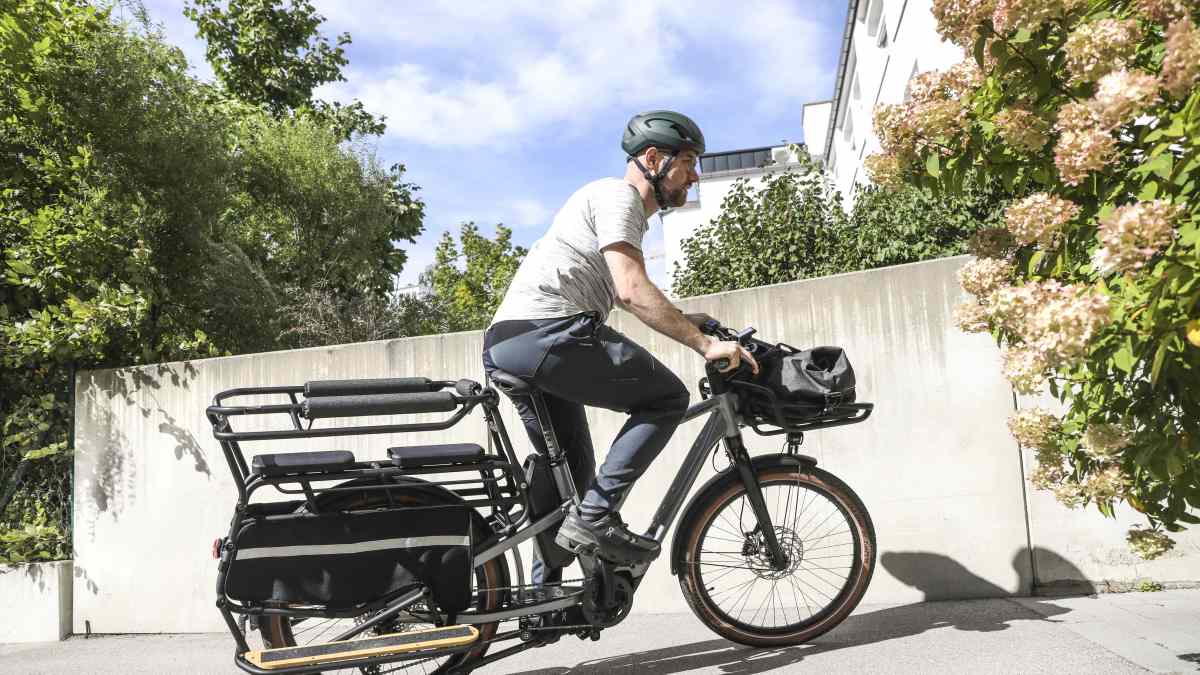
The E Three 500, newly launched for the 2026 model year, follows on from the R500E Longtail V2. Even in what is now the third iteration of this bike, the basic concept remains the same: a rear hub motor, 26-inch front and 20-inch rear wheels, and a long rear rack. Notable new features include the B’Clip-ready accessory system and a colour TFT display. These are complemented by slightly greater battery capacity and a slightly higher motor torque. Which differences really matter in everyday use, We’ll explain this by comparing it with its predecessor. The key question for this test is: does this bike offer a convincing family bike at a comparatively low price, or do the compromises become apparent precisely where safety and handling matter most?
The facts about the Decathlon B’Twin E Three 500
- Price: 2,699 euros, excluding accessories available separately >> available here
- Drive: Vision rear-wheel hub motor with a stated torque of 60 Nm
- Battery: Removable; 711 Wh
- Weight: 39 kg
- Payload: 170 kg permissible payload, including the rider and any passengers; a maximum of 80 kg at the rear and 10 kg on the optional front rack. Permissible gross weight: 209 kg.
- Wheels: 26-inch front wheel and 20-inch rear wheel
- Chassis and brakes: Suntour suspension fork with 75 mm travel; hydraulic Tektro four-piston brakes with 180 mm discs
- Circuit: Microshift, 6-speed
- Everyday essentials: Colour display, frame lock, rear grab rail and footrests, spoke guards, mudguards, reinforced stand and lighting system with a 60-lux headlight, automatic day/night mode and brake light.
- Transport accessories: Rear rack, B’Clip-ready; compatible accessories and front racks are available separately.
Practical test: What really matters
We were able to put Decathlon’s new model through its paces in our everyday family life. We used it frequently to shuttle our two children around, made numerous trips to carry the weekly shop, and also covered longer distances on ‘solo rides’ through the city. The very first thing you notice – and this is typical of longtails – is that, when unladen, the E Three 500 rides surprisingly similarly to a normal bike or e-bike. There’s no need for a drastic adjustment. Compared to other longtails, the B’Twin falls into the ‘smooth-riding’ category. The large front wheel makes a difference here. Other longtails with 20-inch front wheels are, in some cases, even more manoeuvrable, but on gravelly surfaces the B’Twin feels more stable.
The B’Twin is approved for a total weight of up to 209 kilos. This is an excellent figure, allowing for a substantial load of children and/or shopping and goods. However, due to the design of the bike, riding with a heavy load does make it more unstable. The load sits higher than, for example, on a Longjohn. When manoeuvring slowly or at traffic lights, you have to be prepared to actively and firmly steady the fully loaded bike. Yet in our test, even our rather petite 55-kilo test rider managed this at all times. There were never any dicey situations, even when transporting two children (up to 75 kg on the rear carrier in the test). Other cargo bike designs offer easier handling in this respect – but come with other drawbacks.
Packesel – what the cargo bike can do in everyday life
The Decathlon cargo bike’s greatest strength is its ability to carry passengers. Children – or even an adult – can easily climb aboard and sit safely at the rear. This turns journeys, particularly in crowded cities, into a relaxing outing. There’s easily enough room for two children. Toddlers can sit in a child seat, although this cannot be secured using the B’Clip quick-release system. Older children can sit on comfortable benches. Switching between the bench seat and the cargo basket is exceptionally quick thanks to B’Clip. For those who need to switch between them regularly in everyday life, this system ensures stress-free handling.
Everyday tip: The rear bike rack is designed to fit the exact dimensions of Euroboxes from DIY stores. A large box fills the rack completely and can therefore be placed quite securely on the seat cushions. Ideal for the weekly shop or for transporting larger items.
We’d also fitted the optional front luggage rack, which cost 24.99 euros. Here, too, various bags or platforms can be attached using B’Clip. This is particularly useful for carrying a bit of luggage in addition to two children in the rear. Due to the design of the system, it’s a bit trickier to fit large bags or rucksacks directly in front of the handlebars. However, in everyday use, the front carrier was definitely a great help.
The engine – is it powerful enough?
The Vision hub motor provides a fairly steady, ‘van-like’ drive. It doesn’t feel intrusive, but it isn’t particularly sporty either. Getting from A to B in comfort – that’s the motto. And it works a treat. Even the Eco mode is relatively powerful, so you’ll hardly break a sweat on flat ground, and when unladen, you’ll reach a cruising speed of 25 km/h quickly and effortlessly. Although hub motors are generally very quiet, the Vision motor is always clearly audible and doesn’t feel any quieter than, for example, a Bosch mid-drive motor.
The start-off assist is a handy feature, as a quick press of the lever allows the B’Twin to set off effortlessly, even when fully loaded. This small thumb movement quickly becomes second nature. This is because the start-up assist eliminates the ‘lag’ that hub motors typically need to react to pedal pressure.
In flat Munich, hill climbs were the exception – and never lasted longer than one or two minutes. When the gradient gets steeper, the lower assistance levels are no longer sufficient. However, with full power, short hills aren’t really a problem, even when fully laden. You do have to pedal a bit harder, though. This test cannot answer the question of how the nominally weaker 60 Newton-metres would fare in truly mountainous terrain. Experience shows, however, that proper hill climbs are not the forte of hub motors. This is where the B’Twin might reach its limits.
Strengths and weaknesses
Strengths
- unbeatable price
- good handling
- Flexible transport options with quick-release fasteners (B’Clip)
- Useful features and accessories
Weaknesses
- limited engine power on hills
- Simple fittings, with no luxury features

Florentin Vesenbeckh
Editor CvD