


In this article, we use so-called affiliate links. With every purchase through these links, we receive a commission from the merchant. All relevant referral links are marked with . Learn more.
Taking two children to nursery, then to the supermarket, and to the sports club in the afternoon: for these tasks, a cargo bike needs, above all, a sound basic design. The affordable B’Twin E Three 500 from Decathlon. The Qio Long CLAx It can perform the same tasks, but with a higher-quality drivetrain and numerous comfort features, it sets itself apart. As a result, it costs more than twice as much. The key question is therefore not just: ‘What more can the more expensive bike do?’, but also: ‘How much more comfortable is it when doing the same job?’ We have tested both longtails extensively and compared them side by side.
Editor’s CONCLUSION
For predominantly flat everyday journeys, the B’Twin from Decathlon is already a compelling family bike. The Qio justifies its higher price tag primarily through greater comfort, lower maintenance requirements and a more powerful electric motor. However, the higher price does not automatically mean you get more carrying capacity or greater everyday practicality.
Decathlon and Qio: The key differences
| Characteristic | Decathlon B’Twin E Three 500 | Qio Long CLAx |
| Base price according to individual test | 2,699 euros >> available here | 5,699 euros >> available here |
| Engine | Vision rear-wheel hub motor, 60 Nm | Bosch Cargo Line mid-drive motor, 120 Nm |
| Battery capacity | 711 Wh, removable | 800 Wh, removable, optional second battery (800 Wh) fitted to the bike |
| Circuit | Microshift 6-speed derailleur | Enviolo continuously variable hub gear system with automatic function |
| Drive | Chain | Straps |
| Suspension | Suntour suspension fork, 75 mm travel | SR Suntour Mobie Cargo suspension fork and suspension seatpost |
| Adjusting the size to suit different riders | Seat post with quick-release mechanism to prevent twisting; handlebar height can only be adjusted via the stem | Cockpit height is infinitely adjustable via a quick-release mechanism; quick-release mechanism on the seat post |
| Brakes | Tektro four-piston hydraulic brakes, 180 mm discs | Magura Louise four-piston hydraulic brakes |
| Front/rear wheels | 26/20 inches | 20/20 inches |
| Maximum permissible weight, including the bicycle | 209 kg | 200 kg |
| Maximum load on the rear bike rack | 80 kg | 80 kg |
| Extras | Features include a grab rail, footrests and spoke guards as standard; B’Clip-ready rear rack and frame lock fitted as standard | Suspension seat post as standard; allow for additional passenger and cargo accessories, |
Mid-engine vs. rear-wheel drive
The drive systems of the two bikes differ fundamentally. On the B’Twin E Three 500, the motor is housed in the hub, whilst the Qio features a classic Bosch mid-drive motor. Decathlon demonstrates that an affordable hub motor is sufficient for many transport tasks. Its Vision drive, with a nominal torque of just 60 Newton-metres, provides a steady rather than a sporty ride. In flat urban traffic, this suits the intended purpose well: getting around in a relaxed manner without having to exert yourself unnecessarily whilst carrying children or shopping. In the test, even with low assistance levels, it was possible to ride at a brisk pace when unladen.

The start-assist feature is useful. Simply pressing the lever makes it easy to get the loaded bike moving. This compensates for the slight delay with which the motor responds to pedalling. In stop-and-go traffic, this action quickly becomes second nature.
The Qio, on the other hand, is powered by a Bosch Cargo Line mid-drive motor delivering up to 120 Newton-metres of torque. In our individual test, it impressed with its powerful yet unobtrusive assistance. Its key advantage on more challenging climbs is that: unlike the rear-wheel hub motor, it utilises the bike’s gear ratios. This creates more favourable conditions when speed drops on a hill whilst carrying a heavy load. For long or steep climbs, this design offers much greater reserves of power. The range is also even better with the Bosch system in the Qio.
On the other hand, those who mainly drive on flat terrain have little reason to spend an extra 3,000 euros just for the engine.
Battery: Slightly more power, significantly more potential for improvement
When it comes to the battery, the difference in the basic specification is smaller than the price might suggest. The Decathlon’s 711 watt-hours are compared with the Qio’s 800 watt-hours. That’s 89 watt-hours, or around 13 per cent, more stored energy. So a bike that costs more than twice as much does by no means automatically offer double the range. In everyday use, however, the Qio’s range advantage was clearly noticeable. This is also because the lightest assistance level in the Bosch system is tuned to be more moderate, thereby promoting energy-efficient operation.
For those who really prioritise maximum range, Qio offers a further upgrade option: the ‘Long’ model can be fitted with an optional second battery providing an additional 800 watt-hours. This brings the total capacity up to 1,600 watt-hours. This is particularly useful for long journeys over hilly terrain or for making numerous loaded trips between charges. However, the second battery is not included in the base price.
In-hub gears, belt drives and automatic systems: less effort when riding and maintaining your bike
The drive system, comprising a belt and an automatic Enviolo hub gear, is one of the strongest selling points of the Qio. Not because a traditional derailleur system wouldn’t do the job, but because this more expensive system takes care of several small everyday tasks.
With the Decathlon, you choose the six gears of the Microshift derailleur yourself. Shift down in good time before stopping, then shift up again after setting off: anyone who cycles regularly is familiar with the process. Nevertheless, with children on the back of the bike and in heavy city traffic, it still requires a bit of attention.
The Qio adjusts the gear ratio automatically. You set your preferred cadence, and the Enviolo adjusts the gear ratio continuously. Even after an unplanned stop, you don’t have to worry about finding the right gear to set off in. The practical benefit is less effort required to operate the bike. Especially when setting off with a load, you can concentrate more on your balance and the traffic. Whether you prefer the automatic system is a matter of personal taste. Those who like to change gears themselves, or who are particular about maintaining a specific cadence, will see less value in it.
The belt’s maintenance advantage is less subjective. It does not require chain lubrication, thereby reducing the need for regular maintenance. This is particularly welcome on a longtail bike, as the rear structure and transport accessories can make it difficult to access the drivetrain. That said, it doesn’t make the whole bike maintenance-free. Whether the total extra cost pays for itself through savings on maintenance costs also remains questionable. Here, you’re mainly paying for convenience.
Comfort: Here, you can really feel the extra cost
If you ride both cargo bikes side by side, you’ll notice the difference straight away, within the first few metres. The Qio is exceptionally comfortable. It’s as if you’re wrapped in cotton wool, gliding effortlessly along the cycle path, with minor bumps being well absorbed. Its SR Suntour Mobie Cargo suspension responded sensitively and smoothly during the test. This is a marked contrast to the budget model from B’Twin. Added to this is the suspension seat post, which significantly dampens shocks from the rear wheel. In a direct comparison, the Decathlon model feels considerably harsher – despite its larger front wheel.
Important for families: The suspension seat post enhances comfort for the rider. It does not provide suspension for the rear carrier and therefore does not automatically provide suspension for the children on board. The Qio is not a full-suspension cargo bike.
Another added benefit of the Long Clax is the quick-adjust handlebar height. The entire cockpit can be adjusted using quick-release mechanisms. If two people of different heights share the bike, this design feature becomes a practical advantage: not only the saddle, but also the handlebar position can be quickly adjusted for the next rider.
However, very small riders should definitely take the Qio for a test ride. The suspension seat post requires additional space and may limit the lowest possible riding position. If you’re under 160 cm tall, it can definitely feel a bit cramped. Comfort features are only an advantage if the bike actually fits you.
Brakes: Does more expensive mean safer?
The braking system is another feature that adds value to the Qio. The hydraulic Magura Louise four-piston brakes are contrasted with the Decathlon’s equally hydraulic Tektro four-piston brakes. So this budget bike doesn’t skimp here by using a simple mechanical solution. The braking performance is decent here too. However, particularly during prolonged use and when heavily laden, the greater bite of the Magura brakes is clearly noticeable and offers added comfort and safety.
Transport and handling: Is more expensive also more practical?
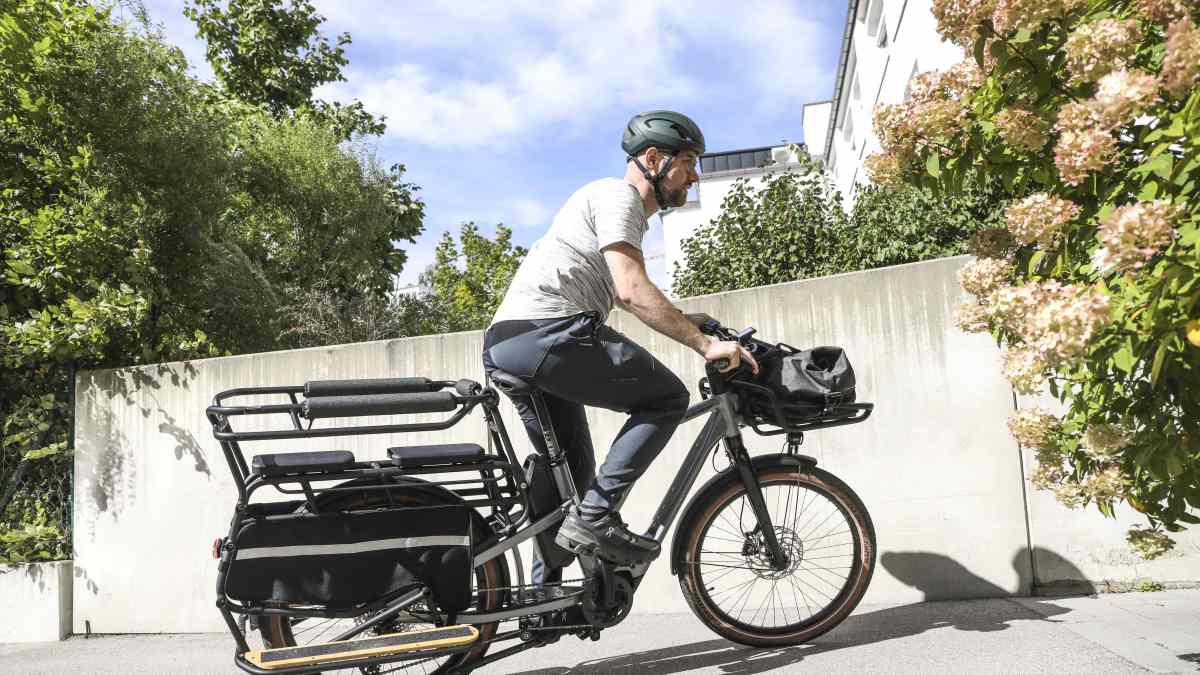
Both bikes feature the Long-tail concept for passenger transport: Passengers sit on the extended rear section. The riding experience is closer to that of a traditional bicycle than that of a three-wheeled trike.
In our test, the Qio felt compact and manoeuvrable; it was easy to handle even when fully loaded. With its larger front wheel, the Decathlon tends to offer a smoother ride. This can be a benefit on loose or uneven ground. So smaller wheels aren’t automatically the better option in every situation.
When it comes to carrying capacity, the cheaper bike can also hold its own. Both rear bike racks are approved for a maximum load of 80 kilograms. The Decathlon’s maximum permissible weight of 209 kilograms is actually higher than the Qio’s 200 kilograms. These figures include the combined weight of the bicycle, the rider and the load, not just the payload.
The Decathlon has a clear advantage when it comes to quickly changing compatible attachments: with B’Clip, for example, the seat and shopping basket can be swapped around in no time. The Qio’s seats, on the other hand, are bolted on. Anyone who transports children in the morning and larger shopping bags later on should take this difference just as seriously as they do the motor and gearbox.
How much do I actually have to spend?
The B’Twin E Three 500 provides a fairly clear answer to the initial question: you don’t have to spend a fortune on a good electric cargo bike that’s suitable for everyday use. At 2,699 euros, it offers a solid foundation for transporting children and doing the shopping. On predominantly flat routes, its compromises are perfectly acceptable for many families.
The Qio Long CLAx can handle the same tasks, but takes more of the work off your hands. The Bosch mid-drive motor, the automatic belt-driven hub gear system, the more responsive comfort package and the quickly adjustable handlebar height really make a difference, particularly with frequent use. The higher-quality brakes round off this package.

Florentin Vesenbeckh
Editor CvD