In this article, we use so-called affiliate links. With every purchase through these links, we receive a commission from the merchant. All relevant referral links are marked with . Learn more.
Text: Johanna Nimrich
Cargo bikes are all the rage. Sales figures reflect the subjective impression that there are more and more of them on German roads. In 2025, around 220,300 cargo bikes were sold in Germany, representing a 26 per cent increase compared with 2021. But when you’re looking into them for the first time, you’re faced with a few questions – we’ll clarify the most important points.
Editor’s conclusion
The term ‘cargo bike’ encompasses a range of different designs, each with its own strengths. The key factors are who or what you want to carry and the routes you cycle on a daily basis. The motor, payload and a suitable parking space should also be on your checklist before you buy.
1 Types of cargo bikes
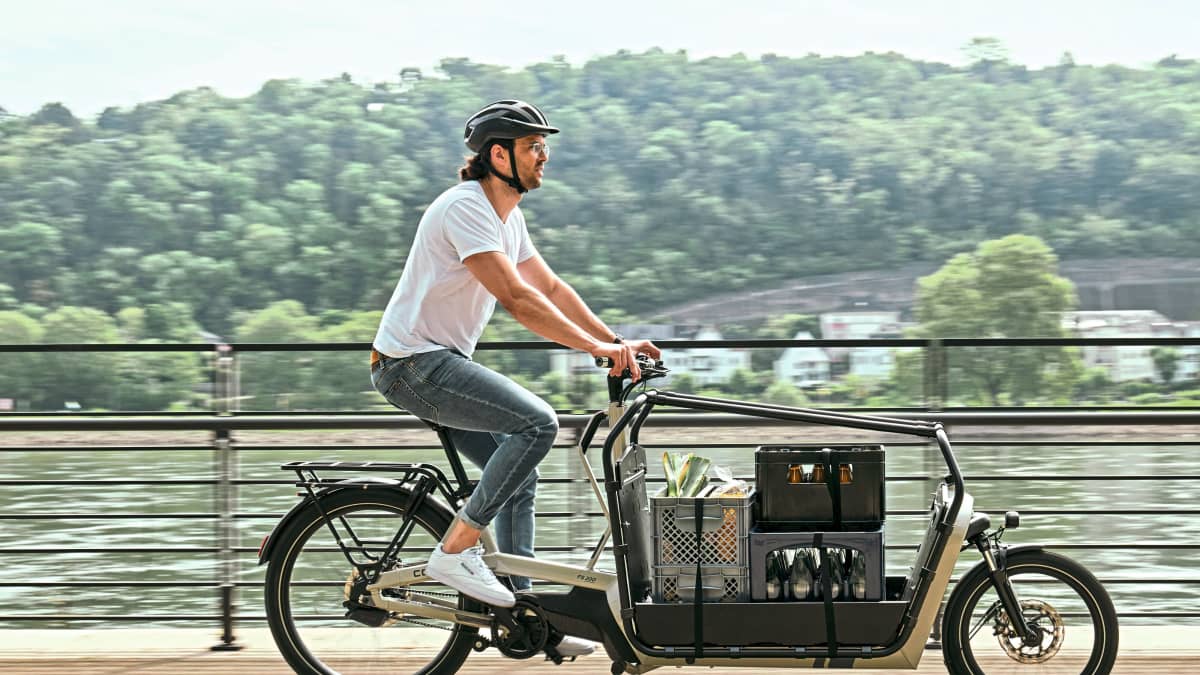
The main way of classifying cargo bikes is to distinguish between ‘Long John’, Long tail and tricycle. With the two-wheeled Long John The cargo is carried in front of the rider; this usually consists of large boxes for luggage or two children. The Long John often allows for heavy loads and, with its weather cover and comfortable seats, offers plenty of comfort for the children on board. The Long tail The front is built like a normal bike, but the rear is extended. When carrying children, they sit either in a child seat or, depending on their age, on a relatively simple bench seat (see Tip 6). The Tricycle By contrast, with (usually) one wheel at the front and two at the back, it handles completely differently. It stands upright on its own and often has room for three or four children. Simple cargo bikes, such as the ‘baker’s bike’ with a larger front luggage rack, receive less coverage in the media and are also less commonly developed by bike manufacturers.
2 The right engine
Cargo bikes have been around for almost as long as the standard bicycle. In the 1930s and 1940s in particular, there were many of them on the roads, serving as a means of transport for tradespeople or for large families to carry their children. But it was only with the development of electric e-bike motors that cargo bikes experienced a huge surge in popularity. Today, cargo bikes without electric motors are rare. This makes sense: whilst transporting loads on flat ground might still be manageable, doing so on inclines is extremely challenging. To get these often heavy cargo bikes – plus their load – moving, powerful motors are required. Mid-drive motors are usually fitted. A classic example is the Bosch Cargo Line, but the Shimano EP8 Cargo is also a popular choice. Torque figures of 75 to 85 Nm are standard. Anyone who regularly has to tackle long inclines on a cargo bike should choose a model with a particularly powerful motor, i.e. one with a higher torque. Otherwise, frustration is inevitable.
3 Payload and maximum authorised mass
Cargo bikes can sometimes carry really heavy loads. It is important to stick to the maximum limits. Manufacturers specify a permissible total weight that may be reached. For cargo bikes, this is often 200 or even 250 kg. That sounds like an enormous amount, but it’s worth doing the maths. The permissible system or gross weight actually refers to the combined weight of the bike, the rider and the payload. Most cargo bikes weigh 30 kg or more; some can even weigh up to 50 kg. In addition, there are separate weight limits for each loading area. The long luggage rack on longtail bikes is often limited to 60 kg, whilst the cargo boxes on Long John models can sometimes carry up to 100 kg.
4 Equipment and accessories
The cycling industry has responded to the growing popularity of cargo bikes in recent years with a range of new products. Schwalbe has launched the Pick-up and the Smart Sam Cargo The range includes specialist tyres for cargo bikes; the Enviolo Heavy Duty hub gear and its successor, the Utility, shift gears even under heavy loads. Manufacturers have generally put together a suitable package that meets the demands of everyday cargo bike use. Nevertheless, it’s worth taking a closer look, and you shouldn’t cut corners in the wrong places: for example, is the kickstand really sturdy, and how much force do you need to lift the bike off the ground or get it moving again? Are hydraulic disc brakes fitted? For those wishing to carry children: do the seating options look comfortable, or will the child have to lean against cold metal bars, for example? Before buying or leasing, you should be clear about the bike’s primary use, where it can be parked and the topography of the routes you’ll be taking most often. Many manufacturers offer a wide range of suitable accessories; some bikes are compatible with common systems – for example, Maxicosi baby car seats can be securely clipped in, or Euroboxes can be positioned perfectly. Many cargo bikes are fitted with a frame lock. That’s a good start – after all, you can’t just steal a bike that heavy. For added security, we recommend suitable cable locks or long chain locks.
Transporting 5 items safely
A big shop, crates of drinks, tools, furniture or the Christmas tree – you can transport all sorts of things on a cargo bike. What you can carry and how much depends mainly on the load limit, but also on the size. The law stipulates that a bicycle with a load may have a maximum width of 2.55 m. And to be even more precise: strictly speaking, any load that protrudes 40 cm to the side must be fitted with an additional light (at the front and rear!). And whatever the load, it must be secured in such a way that it cannot slip or fall out, even in the event of emergency braking or evasive manoeuvres. There are covers and also transport boxes with lids; for open-top bikes, tension straps are ideal. In addition, the lights must not be obstructed and the handlebars must be accessible for normal use.
Take 6 children and adults with you
Unlike the rules for normal bicycles, there is no age limit for carrying passengers on a cargo bike. Older children and even adults may be carried, provided the bike is approved for this purpose. However, the passenger must have a suitable seat. For children up to the age of 7, the law stipulates ‘special seats’, although these are not defined in detail. It must also be ensured that their feet cannot get caught in the spokes. Many cargo bike manufacturers issue their own recommendations. On longtails, children up to around four years of age should sit in a proper bicycle seat and therefore be strapped in. There are no seatbelts on the bench seat of a longtail, which is why there should at least be good footrests or foot supports, as well as a railing (also known as a ‘monkey bar’) running all the way round. Long John bikes usually have seats with safety belts for children. However, adults are also allowed to sit on them without a belt. Please observe the weight limits!
7 cycle paths and roads
Cargo bikes are treated the same as other bicycles under the law, which means that, in principle, they belong on cycle paths. If use of the cycle path is compulsory, this applies to all types of bicycle. However, if the cycle path is, for example, dirty, obstructed or otherwise unsuitable, cyclists may use the road instead. Are cargo bikes too wide for the existing cycling infrastructure? Yes and no. Single-track cargo bikes are generally only as wide as the handlebars of any other bicycle, i.e. 60–80 cm. On straight stretches and on well-maintained cycle paths, therefore, there are no restrictions to worry about. Things can get tricky, however, with traffic barriers and tight bends. Some cargo bikes have a fairly large turning circle and require careful manoeuvring in tricky spots. This also applies to multi-track cargo bikes, which are generally slightly wider due to their cargo box.
8 Parking space wanted
Compact cargo bikes such as the Muli, with its foldable basket, as well as most longtail bikes, fit into standard cycle parking spaces. Things get trickier with the Long John. What many people don’t realise is that, if you make the most of the available space, you’re allowed to park your cargo bike in a normal car parking space. These spaces aren’t reserved for cars alone. In practice, this is a viable solution for a quick stop, but there are usually no facilities to secure the bike properly – that is, to chain it to a fixed object such as a lamppost. Local authorities also have the option of marking parking spaces specifically for cargo bikes, identifiable by a parking sign combined with a cargo bike pictogram.
9 Adjusting driving behaviour
Don’t worry, riding a cargo bike isn’t rocket science. However, inexperienced riders should definitely take a short test ride without a load before carrying goods or, indeed, people. Depending on the type of cargo bike, you’ll need to adjust your riding style. Whilst longtails ride just like normal e-bikes, the adjustment to a Long John is a bit more significant – which is also a mental challenge, as your brain first has to realise that the bike can be ridden quite normally, even though it looks completely different. After the first few kilometres, you’ll get into a routine. One thing is certain: riding with foresight is more important than ever to protect your load. Abrupt braking is felt quite sharply, even by any passengers on board.
10 Ways to finance a cargo bike
Found your dream bike, but it’s so expensive? Fortunately, there are various ways to finance the cargo bike you want. First of all, there’s 1. Leasing as a sensible option, provided the employer is on board; 2. payment by instalments, which is available at many larger retailers; and 3. funding through local authority schemes. The government currently only provides funding for cargo bikes for commercial use, i.e. for businesses and the self-employed. A few federal states – currently Hesse and Saarland – as well as some towns also offer a grant to families and private individuals when purchasing a cargo bike. As this situation is subject to change at any time, it is worth checking with your local authority.