


Canyon Spectral:ON vs Cube Stereo Hybrid: A battle in the budget carbon bike league
Josh Welz
· 24.07.2026


In this article, we use so-called affiliate links. With every purchase through these links, we receive a commission from the merchant. All relevant referral links are marked with . Learn more.
Conclusion: The Cube comes out on top overall, whilst the Canyon is the better choice for trail enthusiasts
The Canyon Spectral:ON CF 8 holds its own despite its less powerful motor. Its full-carbon frame, low centre of gravity, agile mullet setup, longer travel and more trail-oriented spec make it a more exciting and affordable bike for riders who prioritise riding enjoyment on the trails. However, in a head-to-head comparison, it doesn’t quite measure up when it comes to the overall package. The Cube Stereo Hybrid ONE44 HPC Race 800 is, objectively speaking, the more powerful e-all-mountain bike, purely because of its modern drivetrain.
Two carbon e-MTBs, two large 800 Wh batteries and a price range of around 4,000 euros: the Canyon Spectral:ON CF 8 and the Cube Stereo Hybrid ONE44 HPC Race 800 are pitted against each other with similar specifications. On paper, the main difference between the two bikes is the motor. Whilst Canyon relies on the somewhat outdated Shimano EP801, the Cube is powered by the significantly more modern fifth-generation Bosch Performance Line CX. But is a more powerful motor enough to decide the contest? Or can the Canyon hold its own with its full-carbon frame, agile mullet wheel configuration, greater suspension travel and a €400 price advantage?

A comparison of the key figures
| Characteristic | Canyon Spectral:ON CF 8 | Cube Stereo Hybrid ONE44 HPC Race 800 |
| Price | €3,999, reduced from €4,499 | €4,399 >> available here |
| Frame | Full carbon | Carbon main frame, aluminium rear triangle |
| Engine | Shimano EP801, 85 Nm | Bosch Performance Line CX Gen5, 120 Nm |
| Battery | 800 Wh, removable | 800 Wh, removable |
| Suspension travel | 160/155 mm | 150/140 mm |
| Training wheels | Mullet: 29/27.5 inches | 29 inches (27.5 inches for size S) |
| Weight as measured by BIKE | 24.3 kg | 24.1 kg |
| Suspension fork | Fox 36 Rhythm | Fox 36 Float AWL HD Sport |
| Damper | Fox Float Rhythm | Fox Float Rhythm R |
| Circuit | Shimano XT rear derailleur and XT shift levers, SLX cassette | Shimano XT rear derailleur, Deore shift levers |
| Brakes | Shimano SLX, 4-piston, 203 mm | Shimano BR-MT420, 4-piston, 203 mm |
| Permissible system weight | 130 kg | 160 kg |
| Special features | Low battery centre of gravity, GPS function, ‘mullet’ design | Angle adjustment on the headset, UDH derailleur hanger, X-Connect interface |
Motor: The Cube leaves the Canyon in its wake
The biggest difference between the two e-MTBs lies in the drive system. The Cube uses the fifth-generation Bosch Performance Line CX. With up to 120 Nm of torque, 750 watts of peak power and 600 per cent assistance, the Bosch is currently only outperformed by the Avinox powerhouse. When it comes to modulation, the Bosch is beyond reproach, whilst the Extended Boost function helps on uphill sections. In short: a state-of-the-art motor.
By contrast, Shimano’s EP801 is in a different league altogether. Whilst the Japanese model has always performed reliably, it cannot keep up with the modern high-performance motors in terms of either power or modulation. However, 85 Nm of torque and 400 per cent assistance are certainly sufficient, provided you don’t measure them directly against the ‘steroid-fuelled’ competition. What’s more, the Japanese model is compact and lightweight. On long rides and on moderate gradients, the EP801 operates pleasantly smoothly. Those who frequently switch between assistance modes can make good use of its efficiency. However, as soon as the going gets very steep and technical, the Bosch really shows off its raw power and lively dynamics. On serious uphill trails, the EP801 doesn’t stand a chance against the Bosch CX.
A point for the Cube: The Bosch CX Gen5 has more power and is better suited to tough climbs.
Battery: A tie in terms of capacity
Both bikes are fitted with an 800 Wh battery. This means they are well equipped for long day trips and plenty of elevation gain. Canyon developed its aluminium battery in collaboration with Darfon. It can be removed from the frame by sliding it downwards. Thanks to its flat design, the frame profile remains very slim; furthermore, it sits low in the down tube, thereby contributing to the Canyon’s low centre of gravity.
Cube uses the Bosch PowerTube 800. This battery is also removable and can be charged either directly on the bike or outside the frame. One drawback of the Cube is the included Bosch charger, which is rated at just 2 amps. As a result, the large battery takes a relatively long time to fully charge.
When it comes to power consumption, one thing is clear: the CX in the Cube drains the battery more rapidly than the somewhat underpowered Shimano. However, in practice, the range depends heavily on the assistance level, rider weight, elevation gain, tyre pressure and riding style. There’s no debate about the weight: at 3.9 kilos, the Bosch PowerTube is significantly lighter than the 4.6-kilo Darfon battery in the Canyon. This negates the weight advantage the mail-order bike would otherwise have thanks to its full-carbon frame.
A point for both: Both 800 Wh batteries offer a long range. The Canyon stands out thanks to its flat down tube design and low centre of gravity, whilst the Cube stands out thanks to its lighter battery.
Chassis: More reserves on the Canyon
When it comes to suspension travel, the Canyon has the edge. The Spectral:ON CF 8 offers 160 millimetres at the front and 155 millimetres at the rear. The Cube offers 150 millimetres at the front and 140 millimetres at the rear.
At the front, both bikes are fitted with a Fox 36. The Canyon features the Rhythm, whilst the Cube uses the Float AWL HD Sport. Both forks are designed for comfort and touring, but offer fewer adjustment options than higher-priced Fox models. In the case of the Float AWL HD Sport, you even have to make do without a compression adjustment. This is a drawback compared to the Fox fork on the Canyon.
On the trail, the Canyon’s longer suspension travel offers greater confidence on challenging descents. In the BIKE test, however, the rear suspension exhibits a rather linear response curve. Active riders who like to build up speed in banked corners or jump over ledges will find the mid-travel range lacks a bit of resistance.
The Cube suspension is comfortable and absorbs bumps well. However, when faced with rapid successive impacts and aggressive riding, the simpler Fox setup reaches its limits sooner. The 2.6-inch-wide Schwalbe Nobby Nic tyres are very comfortable on long rides, but lack precision and cornering grip when pushed to the limit.
A point for Canyon: The longer suspension travel and the more trail-oriented design provide greater reserves on descents and more riding enjoyment on the trails. The Cube impresses with its comfort and confidence-inspiring handling, making it more suited to touring cyclists.
Geometry and handling: agile versus smooth-running
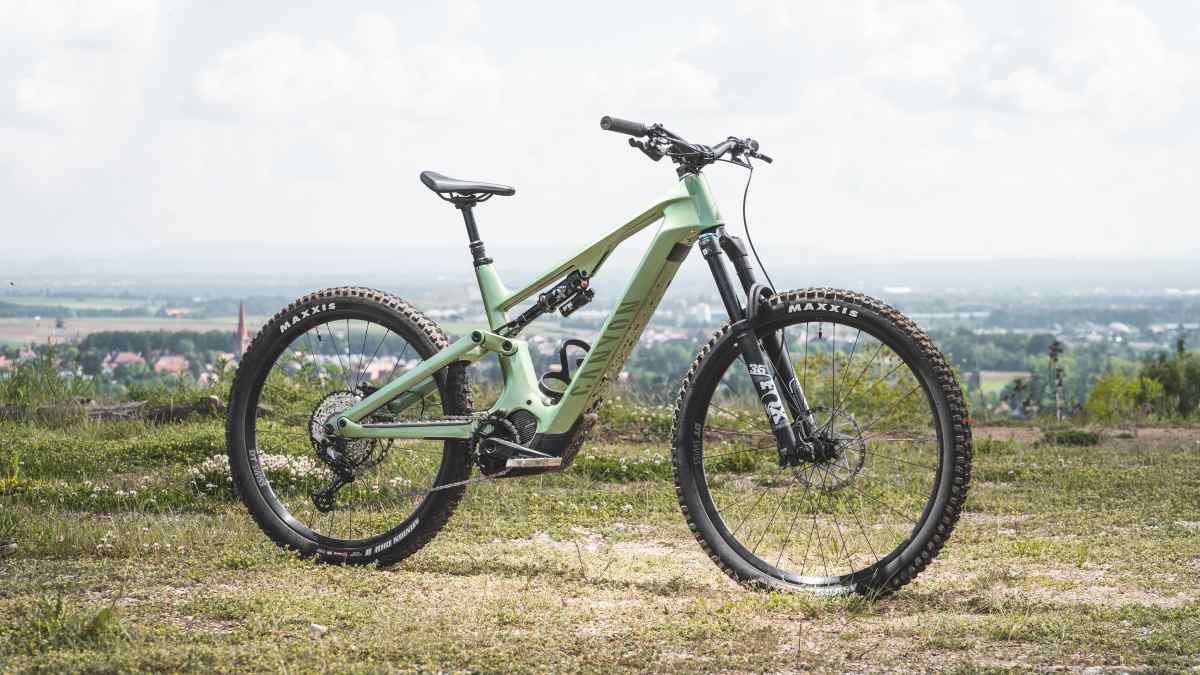
The Canyon features a ‘mullet’ design. The 29-inch front wheel rolls confidently over roots and steps, whilst the 27.5-inch rear wheel keeps the bike agile in tight bends and when changing direction. At 440 millimetres, the chainstays are moderately short. This makes it easy to lift the Spectral:On onto the rear wheel and manoeuvre it playfully along twisty trails. Thanks to the battery’s low centre of gravity, the bike feels very stable even on high-speed descents; the long reach and generous bottom bracket drop make you feel well integrated with the bike.
The Cube rides on 29-inch wheels, and at 457 millimetres, the chainstays are quite long. That alone hints at the Cube’s more moderate touring character compared to the Canyon. A plus: the head angle can be adjusted using special headset cups. On fast forest tracks and long descents, the Cube, with its long wheelbase, sits firmly on the trail and holds its line reliably. In tight bends and on more technical sections, it requires significantly more physical effort than the Canyon.
A point for Canyon: The Mullet design and the short chainstays make it more manoeuvrable and more fun to ride. When it comes to riding enjoyment, the Canyon comes out on top.
Features: Differences in the details
When it comes to the drive system, the Cube is clearly better equipped. As well as the Bosch CX Gen5, it features the Bosch Purion 400 display, Bosch System Control and a discreet mini remote on the handlebars. For the gear system, Cube combines a Shimano XT rear derailleur with a more affordable Deore shifter. This combination keeps costs down without significantly compromising the drivetrain’s performance. The Cube’s braking system consists of Shimano BR-MT420 four-piston calipers and 203-millimetre rotors. The brakes are at the lower end of the Shimano range, and the levers are quite long. Nevertheless, the brakes deliver solid performance.
The Canyon is fitted with a Shimano XT rear derailleur and XT shift levers, combined with an SLX cassette. The Shimano SLX brakes also feature four pistons and 203-millimetre rotors, whilst the brake levers are more ergonomically designed and slightly shorter. This means that, on paper, the Canyon is somewhat more consistently equipped when it comes to gear shifting.
The tyre set-ups also differ significantly. Canyon fits a Maxxis Assegai at the front and a Maxxis Minion DHR II at the rear. Both tyres are designed more for traction and challenging trails. Cube opts for Schwalbe Nobby Nic Performance tyres in 2.6-inch width. These tyres offer a comfortable ride and are well suited to touring, but provide less precision when ridden aggressively.
The Cube also features some interesting frame designs:
- Steering angle adjustment on the headset
- UDH derailleur hanger
- X-Connect for lighting systems
- Direct-mount chain guide
The Canyon counters this with a GPS function, a robust carbon frame and interchangeable threaded inserts. According to Canyon, the GPS module can remain active even when the bike’s battery is flat.
A plus point for the Canyon when it comes to trail features: All in all, both bikes are very well equipped for this price range. However, we prefer the sportier set-up of the Canyon.
Weight and frame: a narrow advantage for the Cube
On the Cube, only the main frame is made of carbon, whereas on the Canyon, the rear triangle is too. Nevertheless, according to BIKE’s measurements, the Stereo Hybrid ONE44, at 24.1 kilograms, is marginally lighter than the Canyon, which weighs 24.3 kilograms. This is mainly down to the heavy battery. In practice, however, the weight advantage is minimal. Weight distribution is far more crucial. The Canyon positions its heavy battery low and centrally. Thanks to its more compact geometry, it ultimately feels more agile. On both bikes, the cables are routed inside the frame from the headset onwards.
A point for both: Overall, the Cube is a touch lighter, whilst the Canyon, with its carbon rear triangle, feels a bit more upmarket.
A direct comparison of driving characteristics
On long rides, both bikes are comfortable and safe to ride. The Cube climbs with excellent traction and keeps the front wheel firmly on the ground even on steep ascents. The Bosch motor complements this performance with powerful, dynamic thrust. Anyone who covers a lot of elevation gain and doesn’t want to tackle every incline under their own steam will feel right at home on the Cube.
The Canyon feels more playful on the trail. It’s easier to push into corners and manoeuvre more quickly through tight bends. On challenging descents, the Canyon’s greater suspension travel and tyres with better traction provide a greater sense of security. However, due to the linear rear suspension characteristic curve, the Spectral:On feels more supple than sportily firm.
Uphill, the picture is the reverse. The Shimano EP801 is adequate for normal rides and moderately technical climbs, but in a direct comparison it feels noticeably less responsive. The Cube accelerates with a sporty, lively feel and tackles steep sections with significantly less effort.
A point for both: The Cube is a reliable companion for long rides, whilst the Canyon is a fun machine for trail riding.
Value for money
The sporty Canyon has been reduced from 4,499 to 3,999 euros. For that price, you get a high-quality full-carbon frame and a selection of trail-ready components. The Cube is 400 euros more expensive. Its key selling point is quite simply the incredibly powerful Bosch package. Anyone looking for a powerful drive system that performs well on the trail simply can’t go past the Cube. Added to this are the higher permitted system weight and practical frame features. Savings have been made on the suspension, tyres, charger and, to some extent, the gear and brake systems.

Josh Welz
Editor-in-Chief