


National team player without a helmet: Is Manuel Neuer putting the World Cup title at risk?
Sebastian Brust
· 18.06.2026

In this article, we use so-called affiliate links. With every purchase through these links, we receive a commission from the merchant. All relevant referral links are marked with . Learn more.
Manuel Neuer saves the most impossible shots in goal. His reflexes are world-class, his body control legendary. But on a bike, different rules apply. A moment’s inattention, a wet root, a loose stone – and even the best athlete can take a nasty tumble.
The difference: Neuer wears gloves in goal. He should be wearing a helmet on his bike. Just like his team-mate Jonas Urbig in the photo above. The two players from the German national football team did indeed cycle to their final training session in exemplary fashion ahead of their first World Cup match against Curaçao. Unfortunately, however, they were not wearing helmets.
Editorial view
Even goalkeeping legend Manuel Neuer, who reflexively saves shots from the corners of the net, can fall off his bike. Modern bikes can reach speeds at which even professional athletes can lose control. And other road users pose an additional danger. Cycling helmets They provide reliable protection for the head and are now lightweight, well-ventilated and available across all price ranges. Anyone who rides without a helmet risks serious head injuries and sets a bad example for young cyclists.
Why wear a helmet? Speed meets reality
Modern bikes are faster than ever before. With suspension offering plenty of travel, today’s mountain bikes glide effortlessly over trails that would have catapulted hardtail riders of the 90s into the air. The latest, powerful disc brakes can recapture the kinetic energy even of heavy e-bikes. This encourages riders to go faster.
Yet the laws of physics are unforgiving: the faster you go, the harder the impact. Even on simple forest tracks, a bend can become a trap. And on the roads, the mistakes of others become an additional problem – through no fault of your own. Just popping round to the bakery on the corner? That’s precisely when you should be wearing a helmet – think ‘carelessness’.
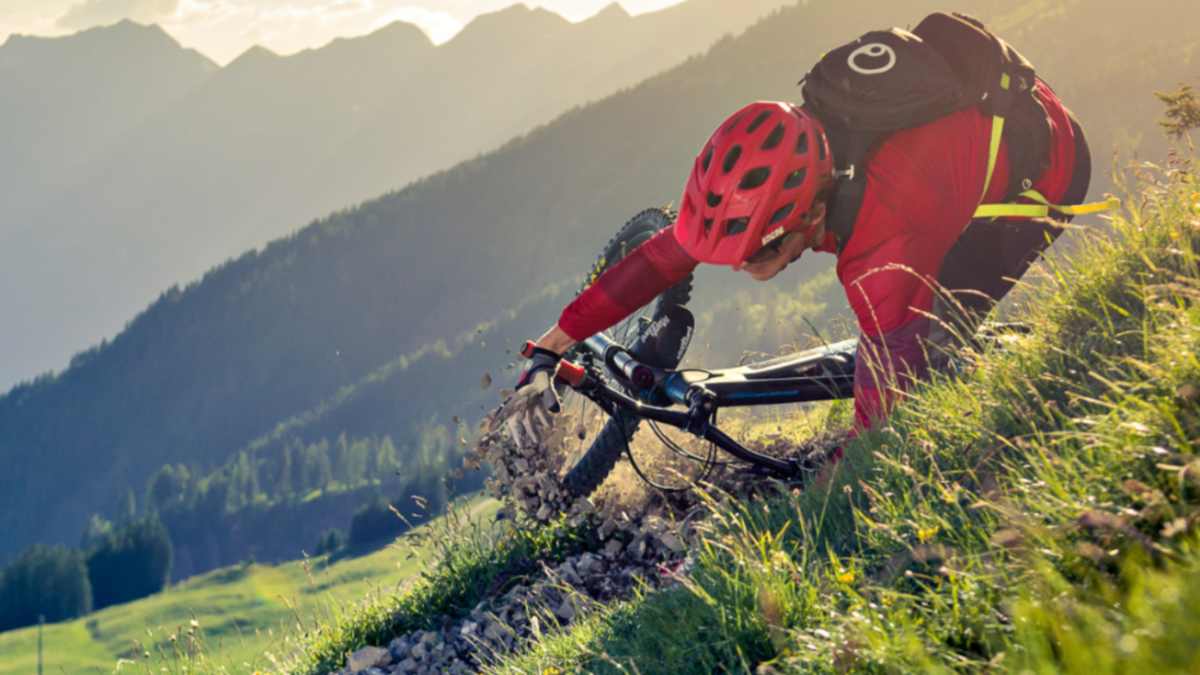
A helmet complying with DIN 1078 protects every head
Modern MTB helmets comply with the DIN 1078 safety standard and offer reliable protection. Even budget models provide adequate head protection, whilst more expensive versions are more comfortable to wear and offer better ventilation. The days of heavy, poorly ventilated helmets are over. Today, there’s a style to suit every taste, from understated to eye-catching.
A helmet is as much a part of a bike as tyres, gears and brakes. Anyone who rides without one not only risks serious injury, but also sets a bad example for younger cyclists. So, dear Manuel Neuer: wear a helmet when you’re cycling, even if you don’t need one in goal!
Or, better still, why not just do it like Kai Pflaume. The TV presenter says: “For me, it’s about protecting my ability to work,” and also carries an airbag rucksack.
We’ve already tried that one out too – here for demonstration purposes, and much to the obvious surprise of our colleague Max Fuchs, via remote ignition. ;-)
At this point, you will find external content that complements the article. You can display and hide it with a click.
What do you think – about celebrities setting a good example, about helmets, about airbags? Share your thoughts in the comments!
Sebastian Brust
Editor
