


For years, it seemed as if the physical limits had been reached. 85 Newton metres, around 550 to 600 watts of peak power and a weight of 2.7 to 2.9 kilos. All e-bike motors largely had these values in common.
With its first motor, DJI has Avinox M1 startled the industry. The combination of 2.58 kilos of motor weight and 1000 watts of power was already in a new league. The brand new, recently launched M2S (test here) is only slightly heavier, but raises the peak power by another 50 per cent. 1500 watts! That's insane. That's almost THREE TIMES what was the standard for power motors until 1.5 years ago.
From a purely technical point of view, one can only admire the engineering achievements of the Chinese. However, this arms race is not effective. Even the 1000 watts of the M1 motor were simply too much to really make sense off-road. Every E-MTB (yes, every one!) that we have been able to test with Avinox so far has basically been overwhelmed by the excessive power of the motor.
Yes, the power and momentum of the motor makes some difficult passages much easier. But in many really tricky situations, the DJI power simply tries to throw the driver off in wild horse mode. Fortunately, the manufacturers have not reacted with corresponding geometries. Because nobody really wants bikes that ride like a log lorry on the trail. But that would be the logical consequence.
What is really innovative?
I am certain that anyone who can build such a powerful and superior engine could also set new records and push the boundaries in a more sensible direction. Lighter. Smaller. Quieter. More efficient. How about a motor weighing less than 2 kilos with 85 Newton metres and 600 watts of power? That would be innovation that would really make e-mountainbikes better.
Come on, Avinox engineers. I know you can do it!
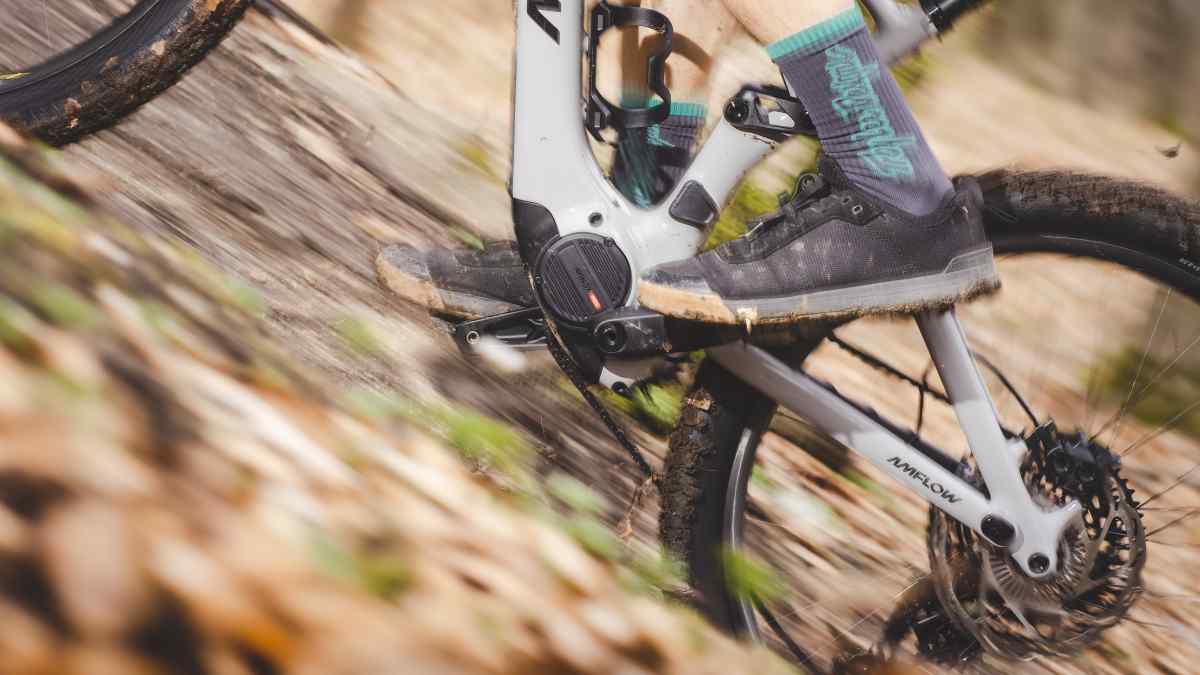
Perhaps such an Avinox motor would even be so slim that it would visually match the newly developed, extremely thin 700 super battery from Avinox. This would pave the way for really stylish e-MTBs that are still powerful and have a long range. The latest Amflow PX Carbon has a super-thin down tube, but the motor sits like a lump at the bottom. That's better!
The reach dilemma
Technically, such a combination would probably not be far-fetched either. Because with the 1500 watts of the M2S, the battery is smoked up faster than a fag in the fingers of a chain smoker. With less power and a system trimmed for efficiency, on the other hand, a powerful 700-cell battery could be the sweet spot between weight and range. And that would really push e-mountainbikes forward.
Of course, I know the argument that you can also drive a super-powerful engine with moderate power. But the excess power inevitably bears moderately useful fruit. The 38 mm chainring on the new Amflow PX Carbon, for example. Because it prevents precisely this sensible, moderate use.
Pedalling up a long Alpine climb in eco mode to save energy? That's simply not possible for normal e-bikers with this gear ratio. Rather, the high climbing gear encourages you to shift up another support level and to slurp up the chain, cassette and battery in fast motion.
E-bikes with 1500 watts - a joke!
Last but not least: E-bikes are so successful, popular and fun because they are legally equivalent to a bicycle. Of course, I know that an Avinox bike must also adhere to the 25 km/h limit. And, of course, it's also debatable whether e-biking with 600 watts of motor power is the same as pedalling a non-motorised bike.
But 1500 watts? Please. That's a joke!



Florentin Vesenbeckh
Editor CvD
